A polished first app is easy to like. The awkward part arrives when a client needs different permissions, a payment fails, or the app faces another round of edits. Softr reviews become more useful when read across that commercial journey, not as a single star score. I'm Elin. This article separates user reports from current product evidence and turns both into a practical fit test.
How We Evaluated Softr Reviews
Review Aggregators, Editorial Sources, Recency, and Disclosure Labels
I did not run a private paid-plan build for this article, so I am not going to dress up a source review as hands-on testing. Instead, I checked current Softr user reviews alongside Softr's own product and billing materials on September 7, 2026.
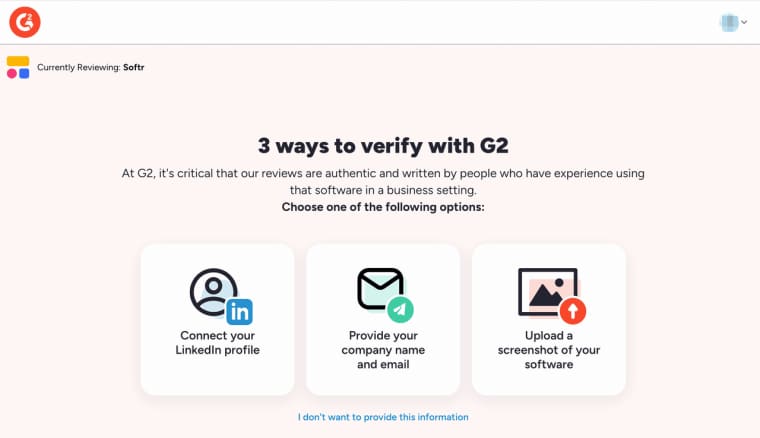
The review sources need different handling. Softr G2 reviews include identity checks and collection labels, while Softr Capterra reviews distinguish verified and incentivized submissions. Trustpilot identifies review status and collection context, including unprompted submissions. These labels do not prove a claim, but they show how much context it needs.
I looked for repeated themes, recent dates, stated use periods, and real workflow details. A report about role limits after months of use carries different weight from "great tool." One outage report creates a test case, not proof of a universal reliability problem.
That is the first rule of reading Softr pros and cons: use reviews to decide what to test, then use current product evidence and your own pilot to decide what to buy.
Softr Across the Commercial App Journey
From Idea Brief to Monetization Readiness and Iteration
The useful question is whether one commercial idea can move through six stages without falling apart.
Start with a brief such as: "Create a paid client intake portal for a small brand studio. Clients submit a brief, upload assets, see project status, and access approved files. Account managers see assigned clients only."
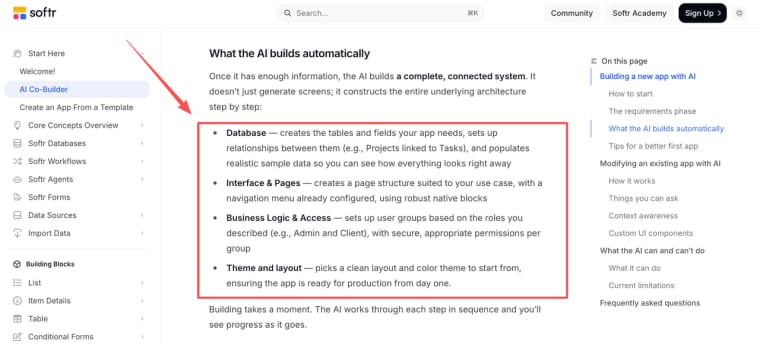
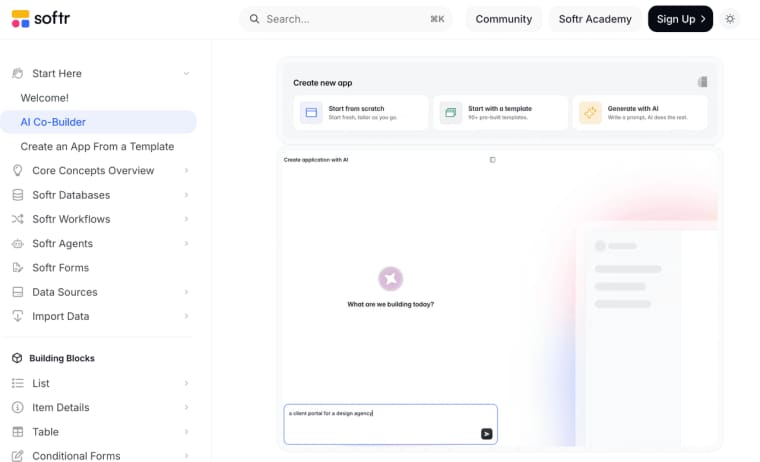
Softr's AI Co-Builder can turn a plain-language request into connected databases, pages, blocks, sample data, and user groups. That establishes a credible route from idea to usable structure. It does not establish that the generated permissions, data fields, or payment states match your business.
Test with two sample clients and two staff roles. Publish a test version, connect the intended data, then add a contractor who can view assets but not billing or private notes. This second change shows whether the team understands the structure well enough to operate it.
A checkout button is not a paid product. Users must receive the right access, keep it when they return, and see a sensible state if payment fails or a subscription ends. Change the offer once too. If existing users break, the launch path is incomplete.
Softr Review Themes Across the Launch Journey
Starting, Building, Validating, Shipping, and Operating Experiences
Across the sampled review platforms, the most consistent positive theme is starting speed. Reviewers often describe short learning curves, quick database-to-interface setup, and useful results without conventional development. That matters for founders who already understand the workflow they want.
Customization becomes the tension point. Some reviewers describe enough flexibility for portals and operational tools. Others report friction when layouts, interactions, permissions, or app logic become more specific. That is not necessarily contradictory. A client portal and a distinctive consumer SaaS product place different demands on the same builder.
Do not validate with empty dashboards. Add realistic records, duplicate names, missing files, expired clients, and a user in the wrong group. A clean demo can hide a weak data model.
Shipping introduces domains, mobile behavior, SEO, and payment configuration. Operating introduces support response, credit visibility, workflow limits, rollback, and handoff. User comments about bugs, support, or cost belong here, but they remain reported experiences. The founder still needs a controlled pilot and a written failure path.
User Feedback and Official Product Evidence
Documented Capabilities, User Experiences, Plan Limits, and Open Questions
This table uses current public materials checked on September 7, 2026. It is not a scorecard. Each row is a question to test with the same app brief.
| Commercial stage | Softr evidence and open question | HappySeeds evidence and open question |
| Idea to usable app | AI Co-Builder creates a connected starting structure, followed by editable blocks and settings. Test whether the first data model survives a role change. | Plan-first, prompt-to-app creation is described in the current HappySeeds release history. Test the generated plan, preview, and second revision rather than assuming the first result is complete. |
| Real data and access | Softr supports app users, team and client user categories, databases, groups, and plan-based permission limits. Test each role with realistic records. | Auth and database support are publicly described, but account behavior, limits, and data responsibilities still need checking in the intended workspace. |
| Publish, domain, and SEO | Apps can be published to a Softr address; paid plans include custom-domain capacity, and Softr provides page and site SEO settings. Test the live URL separately from preview. | Publishing and custom domains are described as product layers. Verify plan eligibility, indexing behavior, metadata, and the actual customer URL before launch. |
| Payments and commercialization | Softr's Stripe Checkout integration supports one-time payments and subscriptions. Test paid access, cancellation, refunds, and failed-payment states. | Payments are part of the stated app stack, but the founder remains responsible for provider setup, product access logic, refunds, and customer communication. |
| Ownership, export, and maintenance | Workspace ownership can be transferred under stated conditions. Source-code export was not clearly established in the reviewed materials, so confirm portability before purchase. | The reviewed public materials do not clearly establish source-code export or a complete handoff package. Confirm data export, credentials, deployment ownership, and developer takeover needs directly. |
| Pricing and credits | The current Softr plan structure lists Free at $0, Basic at $25 monthly, Pro at $119 monthly, Business at $395 monthly, and custom Enterprise pricing. Annual billing has lower effective monthly rates. User allowances, domains, workflows, and AI credits affect the real total. | Current credit-based plans display Free at $0, Pro from $19.90 monthly with 200 credits selected, and Max from $99.90 monthly with 1,000 credits selected. Higher credit options change the price, and unused credits do not roll over. |
Prices are snapshots. Check live checkout, billing period, user count, credits, domains, and integrations before committing. Compare the cost of building, serving, and revising the same workflow, not plan against plan.
Who Softr Fits for a Monetizable App Test
Trial Conditions, Commercial Requirements, and Portal-Fit Trade-Offs
Softr is worth testing when the product is naturally data-backed and role-based: a client portal, directory, member area, approval system, internal workflow, or operational app. It also suits founders who want a visual editor after AI creates the starting structure.
The pilot should include one buyer, a narrow outcome, real-looking data, at least two roles, and one payment condition. Run it on the lowest plan that contains the required controls, then calculate the cost at the expected number of team and client users. Free-plan success does not prove paid economics.
Softr may be a weaker fit when the product depends on an unusual consumer interaction, highly custom navigation, portable source code, or behavior that regularly escapes available blocks and permissions. The test brief should expose those requirements before customer onboarding.
So, is Softr worth it? It may be when its structured portal and internal-tool strengths match the paid job, the plan remains workable at real user volume, and someone on the team can maintain the app after launch.
When HappySeeds May Be Worth Considering
Plan-First Prompt-to-App Scenarios for Considering HappySeeds
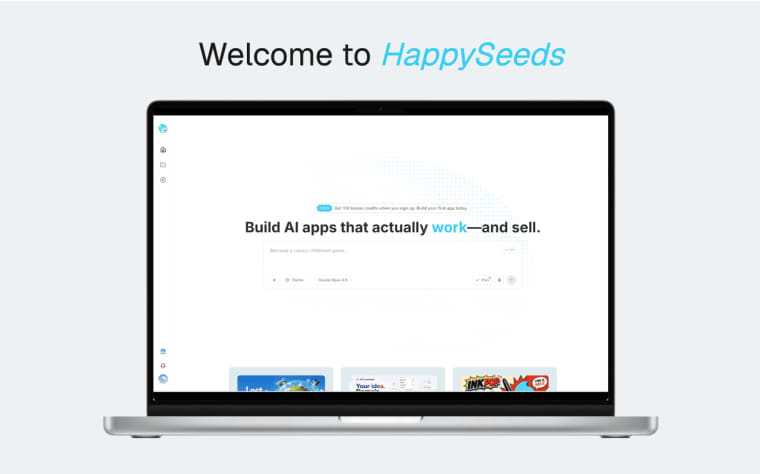
HappySeeds may be worth considering when the founder starts with a rough commercial idea and wants the product plan, visible app, user flow, and launch layers developed in one prompt-led process. The relevant difference is emphasis: Softr combines AI generation with a visual, block-based editing model, while HappySeeds presents a plan-first route toward a generated app.
Use the same brief in both, including roles, records, paid state, published result, and contractor-permission change. Compare manual configuration, verification, and teammate maintenance.
Do not choose HappySeeds because the first screen feels more custom. Confirm data, authentication, payments, domains, credits, logs, export expectations, and support. It is a conditional alternative for a different building preference, not evidence that Softr is unsuitable.
Test the Second Change Before You Commit
The most useful Softr reviews reveal where to look: starting speed, customization, user limits, support, credits, and maintenance. Put those themes into one realistic test, publish it, add a paid state, and request a meaningful permission change. If the product still makes sense, you have stronger evidence than a launch screenshot or average rating.
Explore More Topics
FAQ
Can buyers request accessibility documentation before adopting Softr?
Yes. Ask which product surfaces the evidence covers, when it was assessed, which standard and version were used, and whether the report covers published customer apps or only the builder. If no current accessibility conformance report is available, include manual assistive-technology testing in the pilot.
Where should suspected fake Softr reviews be reported?
Use the reporting process of the platform hosting the review. Save the review URL, visible date, disclosure label, and the specific reason for concern. Avoid publicly accusing a reviewer without evidence. The platform's moderation team should investigate authenticity.
Should procurement teams archive reviews used in their decision?
Preserve the URL, access date, disclosure label, and a short relevant excerpt. Reviews can change or disappear, so record why the source mattered without treating it as a product promise.
Can buyers request a vendor questionnaire before a Softr pilot?
Yes. Keep it proportional. Ask about data location, subprocessors, incidents, account termination, access controls, continuity, and export. A low-risk prototype needs a different review from an app holding sensitive records.
When should Softr review themes be checked again?
Check them before purchase, after a major pricing or product change, and before expanding the app to a more sensitive workflow. Active teams can repeat the review periodically, but their own incidents, support history, and usage data should eventually matter more than public ratings.