I'm Elin. A serious Runway Solaris review has to be a little boring on purpose. The demo is not boring. The idea is not boring. A generated interface that reacts in real time sounds like the kind of thing builders want to touch immediately.
But if you are deciding whether Solaris belongs in a product plan, the useful question is not "Is this impressive?" It is: can a founder pilot it with real users, clear rights, support evidence, and a recoverable workflow today?
As of now, Solaris is still in the early-access application stage, and I haven't been able to get hands-on access yet. The analysis below is therefore based on Runway's official research announcement and demo videos rather than my own product testing.
Quick Verdict: Solaris Is a Research Preview, Not a Launch Stack
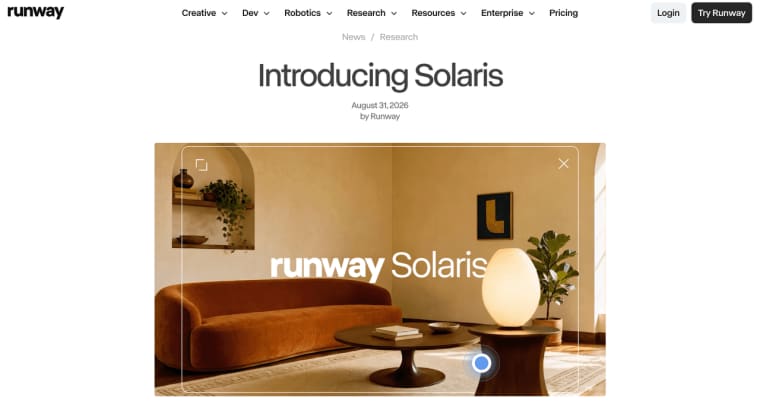
Solaris is worth watching, but it should not be treated as a launch stack yet. Runway introduced Solaris on August 31, 2026, as the first Interface World Model for generated apps and websites. The concept is that the interface is rendered visually, frame by frame, while the user interacts with it.
That makes Solaris important for generated software research. It does not yet make it a normal app builder, developer API, customer-support system, hosted SaaS layer, or commercial deployment environment.
What the Official Solaris Demonstration Establishes
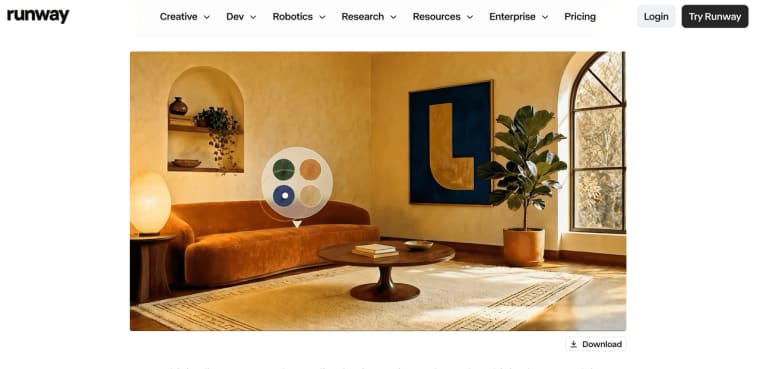
The demonstration establishes the shape of the Solaris AI interface. It is visual, interactive, and open-ended. Instead of moving through fixed coded screens, the user can click, drag, type, or steer an environment that changes continuously.
For builders, the strongest signal is the research direction: software may not always need to begin as static screens translated into code. Solaris explores an interface where the visual scene itself becomes the interaction layer.
The demo also shows why this is still early. Interface work depends on readable text, consistent state, accessibility, integration, and predictable behavior. Those are not minor details. They are the difference between a beautiful experiment and a product customers can rely on.
The Builder Question: Is Solaris Ready for Product Work?
A builder should judge Solaris by one product workflow, not by the whole future of software. For example: could a founder use Solaris to test an interactive product showroom, guided tutorial, or visual configuration flow with real customers?
Evidence Available Today
There is enough evidence for a careful Runway Solaris first look. The research introduction describes real-time visual rendering, interaction through clicks and drags, scene transitions, and a system where reasoning and rendering work together.
It also names hard problems: text stability, trust, long sessions, accessibility, and integration. That matters. A product team should treat those disclosures as part of the evidence, not as footnotes.
Public Access and Product Trial Evidence Still Missing
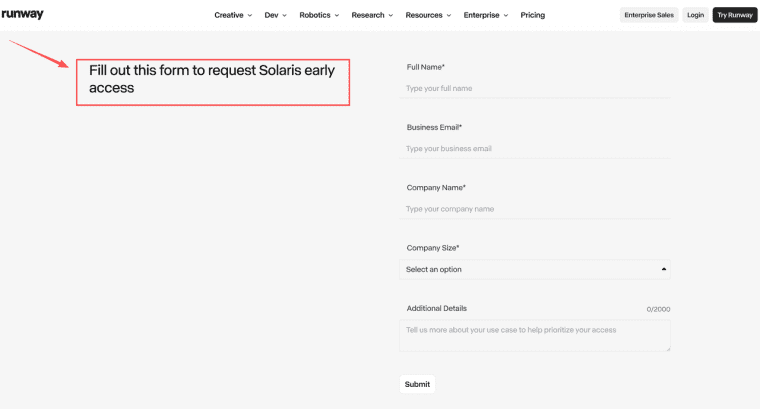
The current public path is a request flow for Solaris early access, not a normal self-serve product trial. As of September 5, 2026, builders still need to verify public access, pricing, API availability, output formats, integration options, commercial terms, and support coverage before planning any customer pilot.
Missing evidence should slow the decision. If you cannot test session records, user permissions, recovery, accessibility, or export behavior, you cannot responsibly promise those things to customers.
Strengths and Trade-Offs of the Research Direction
The strength is obvious: Solaris points toward interfaces that feel more alive than forms, buttons, and dashboards. It could matter for retail, education, product demos, simulations, training, and agent environments.
The trade-off is control. Product teams need to know what the interface may do, what it must not do, and what happens when it is wrong. Runway's service terms cover inputs, outputs, APIs, connected services, and commercial-use boundaries, but Solaris-specific access terms still need review before paid use.
Safety boundaries also matter. Runway's policy framework covers restricted content, rights-sensitive inputs, impersonation, misleading content, and account enforcement. A founder should not assume a generated interface can be used for every commercial flow just because the demo is visual.
Who Should Watch Solaris and Who Should Wait
Watch Solaris if you are a product researcher, interface designer, AI founder, or builder exploring what generated software could become. It is a useful signal for future interaction design.
Wait if you need a launchable product now. A real app still needs accounts, saved data, payment flow, analytics, support, permissions, search visibility, and a predictable recovery path.
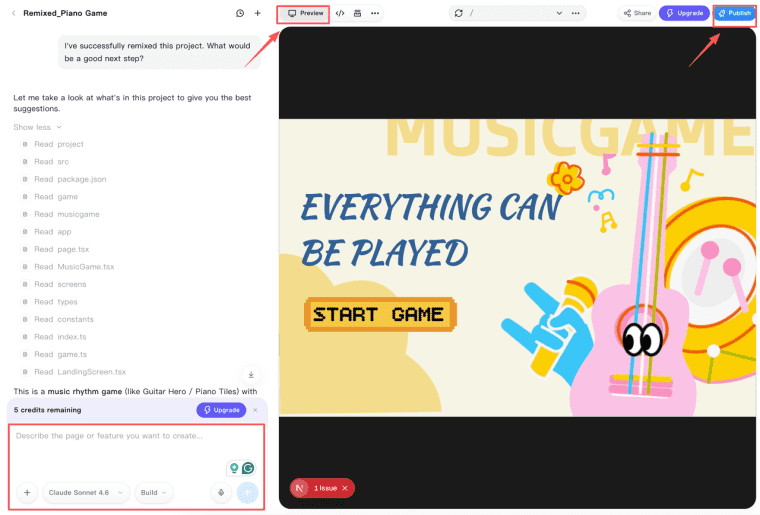
This is where HappySeeds can enter naturally, but only as the visible product layer. A founder can use a platform like HappySeeds to test the customer workflow around the idea: intake, preview, saved records, payment state, and launch flow. Its workspace brings chat-based iteration, preview, cloud services, app settings, auth, payment setup, and publishing work into one environment. That does not mean HappySeeds connects to Solaris. It means builders can validate the product wrapper while Solaris remains a research signal.
Treat Solaris as a Signal Until Evidence Expands
Solaris is interesting because it asks a real product question: what if the interface itself could be generated as the user works? For now, builders should keep the excitement and the checklist in the same room. Watch the research, request access if the use case is serious, and recheck public availability, pricing, integrations, commercial terms, session records, accessibility, and action controls before treating Solaris as production infrastructure.
Explore More Topics:
FAQ
Can teams archive a Solaris session for customer-support disputes?
Not as a confirmed Solaris product feature today. Teams should verify future session history, replay, logs, exportable records, and dispute evidence before using Solaris in a customer-facing workflow.
Does Runway permit commercial use of Solaris-generated interfaces?
Runway has general commercial-use language for outputs, but Solaris-specific commercial rights should be checked against the current access terms and any early-access agreement. This is general information, not legal advice.
Will Solaris preserve user preferences across separate visits?
There is no public product evidence confirming persistent preferences across visits. Builders should wait for details on accounts, session memory, storage, consent, and deletion behavior.
Does Runway disclose provenance markers for generated interface frames?
Runway says it implements C2PA provenance signals for AI-generated content, but Solaris-specific provenance for generated interface frames is not clearly documented in the research preview. Builders should verify what metadata or provenance signals are actually preserved in Solaris outputs before relying on them for customer trust or compliance.
Can product teams restrict which actions Solaris may propose?
The research direction suggests flexible interaction, but product-grade action restrictions are not yet documented for Solaris. Teams should verify guardrails, permission controls, policy settings, and human review before a pilot.