Hi everyone, I'm Elin. A useful Base44 review should not end at "the first app looked good." For a founder, the harder question arrives after the first build: can the app survive a real customer, a role change, a payment setup, a published URL, and a second maintenance request?
Evidence date: August 7, 2026. This article uses official Base44 and HappySeeds materials as the factual base. Third-party review samples were treated only as a way to understand what buyers may expect to verify, not as proof of pricing, support quality, reliability, or production readiness.
How We Evaluated Base44
Official Product Facts, Repeatable Testing, and Third-Party Claims
This Base44 app builder review uses a practical founder test: prompt an app, inspect the first output, publish it, then make one maintenance change that affects data or permissions. That second change matters because many prompt-built apps look strong during the demo but become harder to judge when a user asks for a new role, a new payment state, or a safer handoff. Some teams prefer using OpenCodex when they want more control.
Base44's quick-start materials cover how to describe an app, preview it, test it, and publish it. Code export availability is described in separate plan/developer materials. That is enough to evaluate the workflow shape, but not enough to assume every production detail is solved for every business.
The review lens is six-part: onboarding and workflow, data and authentication, publishing/domain/SEO, payments and commercialization, ownership/export/maintenance, and Base44 pricing plus credits. When a detail is plan-specific, account-specific, or not clearly stated in official materials, it should be treated as something to verify before purchase.
Base44 Features and Product Fit
Prompt-to-App Workflow and Managed Product Layers
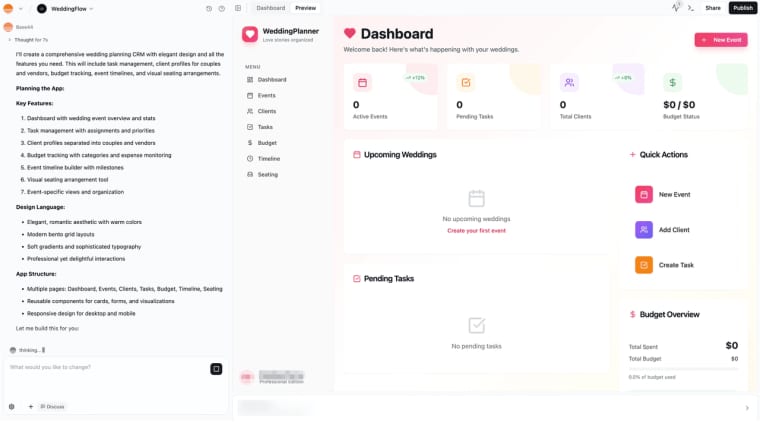
Base44 is built for users who want to describe an app and let the platform generate the first product structure. That makes it relevant for non-technical founders, consultants, and small teams building portals, internal tools, directories, dashboards, booking flows, light marketplaces, forms, CRM-style tools, or early SaaS products.
The important fit is not "can it generate screens?" Many AI builders can generate screens. The better question is whether the builder helps with the product layers around those screens: user signups, permissions, data, publishing, domains, payments, analytics, and future edits. Base44 positions itself as more than a visual mockup tool, which is why founders should evaluate it as a product system.
For a founder, this can reduce starting friction. A consultant with a client intake process can move from a written brief to a working portal faster than assembling separate tools for database, auth, hosting, and UI. The trade-off is that managed speed still needs operational review. You still need to know what plan unlocks the required features, how credits are consumed, how export works, and how the app can be maintained if someone else takes over.
A Reproducible Workflow Test From Brief to Revision
The Initial Brief, First Build, Publishing, and Maintenance Change
This section is a reproducible review framework, not a claim that we completed a private end-to-end Base44 account test. The point is to show the kind of workflow a founder should run before choosing Base44 for a real product.
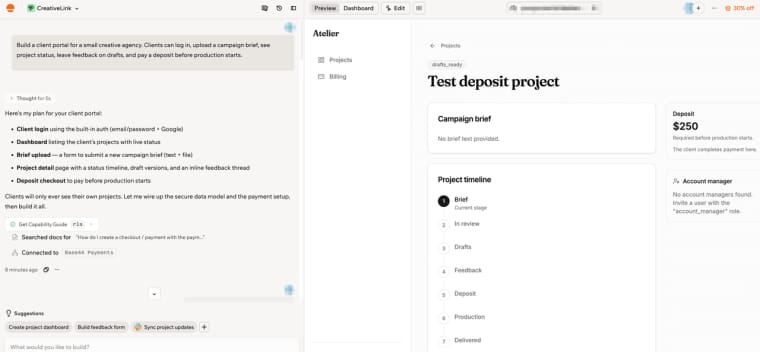
The test brief should be ordinary enough to reveal maintenance risk: "Build a client portal for a small creative agency. Clients can log in, upload a campaign brief, see project status, leave feedback on drafts, and pay a deposit before production starts."
The first output should be judged against practical artifacts, not visual polish alone. Can a client log in? Can they submit a brief? Is the brief stored as a project record? Can the agency update project status? Can feedback be saved and reviewed later? Is the deposit flow represented clearly enough to test?
The second request matters more than the first build: "Add an account manager role that can see assigned client projects, but cannot see billing settings or other managers' clients." This checks whether the app can support permission changes, saved data, and business rules after the first prompt. Base44's build flow covers prompt creation, preview, testing, publishing, and eligible-plan export, but the buyer still needs to run this kind of role-change test inside their own workspace.
Publishing should also be checked from a live URL, not only preview. Base44 describes built-in hosting where apps are instantly live and shareable, plus eligible custom-domain options. A founder should test the published page in a fresh browser, submit realistic sample data, confirm user roles, and verify payment-related states before treating the app as launch-ready.
Base44 Strengths and Trade-Offs
Starting Friction, Scope Control, Credits, Debugging, and Support
Base44's main strength is starting speed. It gives founders a way to move from idea to app structure without writing code first. That is useful for testing a workflow, showing a client a draft, or learning what the product actually needs.
The second strength is managed product coverage. Base44 includes areas that many prototypes forget, such as data, users, publishing, and payments. For founders comparing Base44 alternatives, this matters more than surface design because commercial apps need persistence and access control.
The trade-off is scope control. Broad prompts can create broad apps that are harder to verify. A better founder prompt defines the user, input, saved data, output, roles, and failure states. A vague prompt may spend effort on pages the buyer does not need.
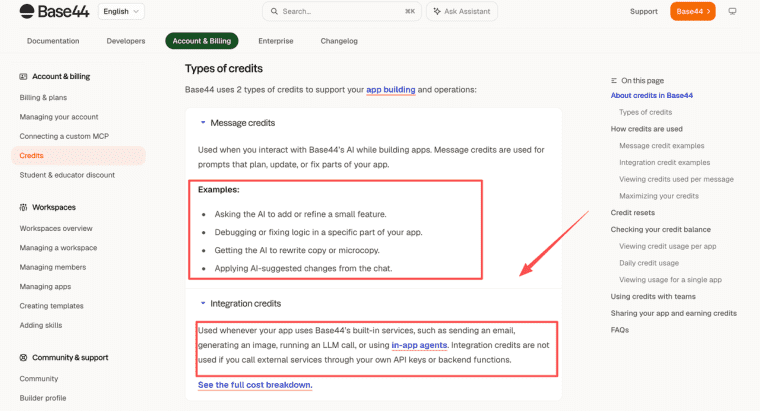
Base44 credits also deserve attention. Base44 explains that message credits and integration credits are consumed by different kinds of platform work, including AI building actions and app integrations such as email, file extraction, image generation, or LLM usage. Founders should test credit consumption with the second maintenance change, not only the first app generation.
Debugging is another area to inspect. A builder can make creation easier, but support still requires evidence: what changed, what failed, which user was affected, and whether the issue was data, role logic, payment, domain, or generated behavior. A founder should not choose any AI app builder without asking how logs, version history, rollback, and support work in the exact plan they plan to use.
Launch, Ownership, and Maintenance Evidence
Base44 is the main subject of this review, but a commercial-investigation reader usually needs one reference point. HappySeeds is included here as a workflow-oriented AI app builder for founders who want to compare prompt-to-app creation against product layers such as auth, payments, database, publishing, and post-launch iteration. The goal is not to declare a universal winner. It is to make the maintenance questions visible before a buyer chooses a platform.
Publishing, Data, Payments, Export, Maintenance, and Costs
The comparison below is a buyer checklist, not a winner-takes-all scorecard. Base44 and HappySeeds can both be relevant, but the useful comparison is the workflow each founder needs to maintain after launch.
| Area | Base44 evidence to verify | HappySeeds evidence to verify | Founder decision point |
| Onboarding and workflow | Prompt-to-app creation, preview, testing, publish, and code export on eligible plans. | Idea-to-app workflow, templates, file context, model choice, Plan mode, preview, and publish. | Which builder gets your first usable workflow closer with fewer vague revisions? |
| Data and authentication | Database, app users, roles, permissions, and dashboard controls should be tested with real sample users. | HappySeeds documents app creation plus cloud layers for database, auth, payments, and domains through its help materials. | Can guest, customer, manager, and admin roles be tested without exposing private data? |
| Publishing/domain/SEO | Base44 supports built-in publishing and custom domains on eligible plans, with SEO features to verify by app type. | HappySeeds supports publishing, custom domains, and cloud configuration through its help center. | Does the live URL support the buyer's launch, not only preview? |
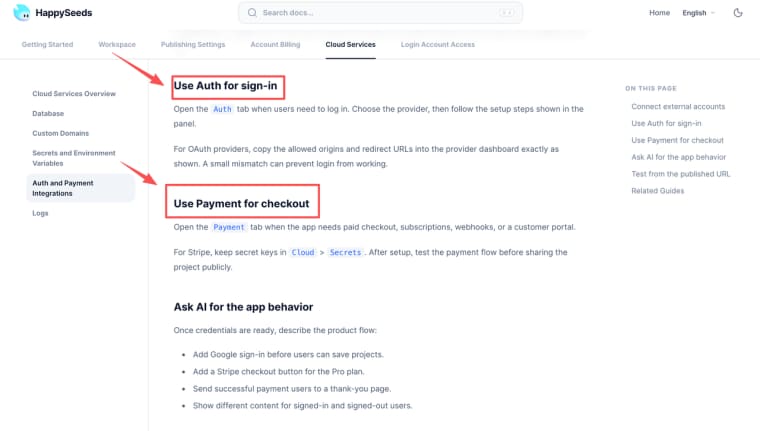
| Payments/commercialization | Base44 Payments materials cover one-time payments, subscriptions, eligibility, verification, payouts, refunds, and settlement reports, so founders should verify provider details and supported regions before launch. | HappySeeds describes Auth and Payment integrations for sign-in, checkout, subscriptions, webhooks, customer portal, and Stripe setup. | Can the app handle failed payments, refunds, account status, and customer invoices? |
| Ownership/export/maintenance | Base44 lists ZIP export and GitHub export on Builder or higher, but buyers should still verify what transfers with the code. | HappySeeds should be checked for handoff, export, logs, and maintenance options in the user's actual workspace and plan. | If a developer takes over later, what files, data, secrets, and deployment steps can be handed off? |
| Pricing/credits | Base44 pricing and credit limits should be checked on the live plan screen before purchase. | HappySeeds pricing should be checked against the current credits, billing, and plan terms. | What does the second maintenance change cost, not just the first build? |
Base44 pricing should be reviewed with three numbers in mind: the plan cost, the number of build credits needed to create and revise the app, and the integration credits consumed when real users trigger services. If a product depends on AI outputs, file uploads, email, or payment actions, the credit model becomes part of the business model.
Base44 GitHub export is also important for buyers who care about developer takeover. Export does not automatically answer every maintenance question. The founder still needs to check environment variables, database ownership, deployment path, third-party service accounts, payment setup, and whether future edits remain easier inside Base44 or outside it.
Who Should Choose Base44
Base44 Fit, Trade-Offs, and When to Consider HappySeeds
Base44 is a good fit to evaluate when a founder wants a fast managed path from prompt to working business app, especially if the app needs signups, data, publishing, payments, and enough structure to test a real customer workflow. It may fit consultants, operators, and small teams who care more about launching a usable internal or client-facing tool than owning every technical layer on day one.
The trade-off is that a prompt-built app still needs maintenance discipline. A founder should not choose Base44 only because the first output looks clean. They should run the second-change test, check credits, test role permissions, publish a live version, inspect payment behavior, and confirm what happens if a developer must take over later.
HappySeeds may be worth considering when the founder wants a guided product-building workflow around app structure, cloud services, customer flows, and post-launch iteration. The comparison should stay practical: if your product needs accounts, payments, saved data, domains, logs, and a non-technical path from idea to working app, compare HappySeeds and Base44 using the same brief and the same maintenance change.
The honest recommendation is simple: choose the builder that makes your second week easier. First-week speed is helpful. Second-week maintainability is what decides whether a product survives.
Choose After the Second Maintenance Change
Base44 looks strongest when the task is to move quickly from a clear prompt to a working app with managed product layers. The real buying decision should happen after the second maintenance change: roles, payments, data, publishing, export, and credit cost all need to survive that moment. If you are comparing Base44 alternatives for a founder workflow, review Base44 against HappySeeds with the same brief, same live-app checks, and same maintenance request. For teams that want to explore the HappySeeds side of that comparison, start with the HappySeeds app-building workflow and then check whether its pricing, credits, and launch layers fit your product plan.
Explore More Topics:
FAQ
Is Base44 free, and what are the free-plan limits?
Base44 has a Free plan, but it is not the same as unlimited production use. Base44's billing materials list 25 message credits per month, 100 integration credits per month, and up to 5 apps on the Free plan. Founders should treat the free tier as a way to test fit, not as proof that a commercial app can run without cost.
How do Base44 credits work?
Base44 separates message credits from integration credits. Message credits are used during the building process, while integration credits are used when the live app triggers built-in services such as email, file upload, file extraction, image generation, video generation, speech generation, LLM calls, agents, or automations. The practical review question is not only "How many credits do I get?" but "How many credits does my real workflow consume after users arrive?"
Does Base44 support GitHub export?
Base44 states that apps can be exported as a ZIP file or to GitHub on the Builder plan or higher. That is a meaningful ownership signal, but founders should still verify what is included in the export, how environment variables are handled, what happens to database data, and whether future maintenance is easier inside Base44 or in an external developer workflow.
Is Base44 pricing predictable for a real SaaS app?
It can be predictable only after a controlled workflow test. Plan price is one part of the cost. Credits, integrations, live user actions, AI calls, payments, support, and future revisions can change the real cost. A serious Base44 pricing review should test the first build and at least one maintenance change, then check actual credit usage before choosing a plan.
What are the best Base44 alternatives to compare?
The best Base44 alternatives depend on the founder's goal. If the priority is a fast prompt-to-app workflow with managed layers, compare AI app builders that support auth, database, payments, publishing, domains, logs, and iteration. HappySeeds may be worth comparing when the buyer wants a guided path from idea to app with commercial product layers, but the fair test is to run the same brief and the same second maintenance change on both platforms.