
A Grok Bot AI app should not begin with the question "What can the Bot do?" It should begin with a smaller, more useful question: What user job can become a visible, reviewable product experience?
Reviewed August 14, 2026: This guide uses xAI's August 11, 2026 Grok Bot beta announcement as the factual base. Treat beta access, subscription eligibility, device availability, features, and policies as launch-time checks before making customer promises.
Define Which Grok Bot This Guide Covers
The new beta is an agent workspace, not the Grok chatbot or a confirmed customer-app API
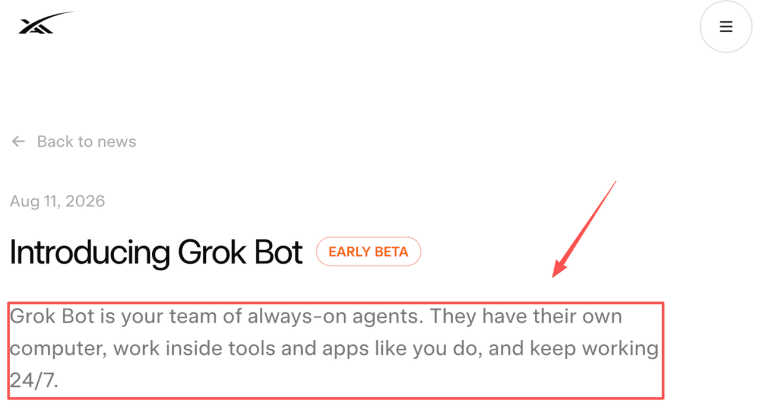
This guide covers the new Grok Bot beta, not the Grok chatbot, @grok on X, Automations, Grok Build, or the xAI API. xAI describes Grok Bot as always-on agents with their own cloud computer, able to work across apps, tools, websites, inboxes, and existing accounts.
That matters for product strategy. The beta may help a team perform background work, but the announcement does not make Grok Bot a confirmed embedded API, white-label product layer, customer-account system, billing engine, SLA-backed platform, or native multi-tenant app backend.
Choose One Job Worth Turning Into an App
Identify the user, trigger, inputs, finish line, and failure cost
To turn a bot into an app, start with one job. Name the user, the trigger, the inputs, the finish line, and the failure cost.
For example, "help with sales" is too broad. "A founder uploads five target accounts and receives reviewed outreach drafts by tomorrow morning" is closer to an AI app MVP. The trigger is a sales sprint. The input is a target list. The finish line is approved outreach. The failure cost is wrong personalization, bad timing, or sending something the founder would not stand behind.
A Grok Bot app only becomes product-shaped when the user knows what to submit and what useful result they will receive.
Map the Bot's Work Behind the User Experience
Separate background tool use from the steps customers should see and control
The Grok Bot workflow may happen behind the scenes: opening tools, checking sites, reading inboxes, updating records, or preparing drafts. Customers do not need to watch every click. They do need to see the parts that affect trust.
Separate internal work from visible control points. The Bot can gather information, but the customer should approve risky outputs. The Bot can draft, but the app should show versions. The Bot can work across tools, but the product should show status, evidence, and next steps.
This boundary keeps the offer understandable. You are not selling mysterious automation. You are selling a controlled outcome.
Design the Customer Journey
Intake, status, review, correction, delivery, and saved results create the app experience
A real AI agent app needs a customer journey. Intake collects the request. Status shows progress. Review lets a person approve or reject output. Correction captures feedback. Delivery provides the finished result. Saved results make the workflow reusable.
For a Grok Bot app, these screens can be simple. A user submits a job, sees "in review," receives a draft, marks issues, approves delivery, and returns later to see history. That is already more product-like than a private Bot thread because the customer has a stable path.
Prototype the Smallest Testable Workflow
Use representative cases and manual guardrails before adding deeper automation
Do not automate everything first. Use representative cases and manual guardrails. If the idea is a client research assistant, test real client briefs. If it is an operations review assistant, test messy checklists, screenshots, and exception notes.
Manual review is not a failure at the MVP stage. It helps reveal where the Bot is reliable, where customers need clarity, and where support will be expensive. A narrow AI app MVP should prove that the workflow is worth repeating before the founder builds deeper automation.
Measure Whether the App Solves the Job
Completion, correction effort, turnaround time, repeat use, and willingness to pay guide the next decision
Measure the workflow, not the model hype. Did users complete the job? How much correction did they need? Did turnaround time improve? Did they return with another request? Did anyone agree to pay for the result?
These signals help a founder decide whether to continue. If users like the idea but never return, the job may not be urgent. If they return but need heavy correction, the product may need stronger review. If they pay for a managed version, the next step may be a better customer interface rather than more Bot complexity.
When HappySeeds May Fit the Prototype
It may help shape the customer-facing flow while Grok Bot access stays external
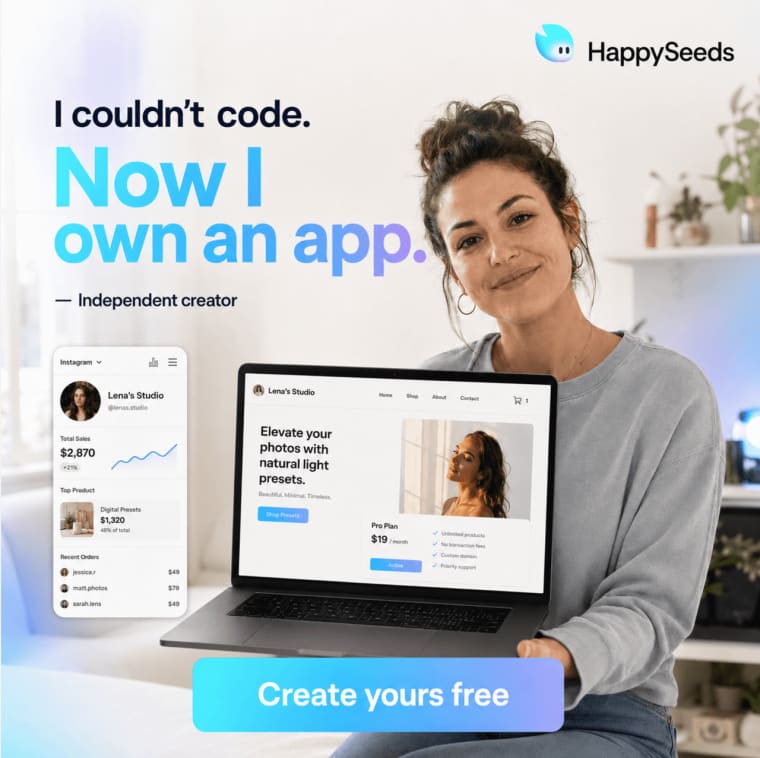
HappySeeds should not be described as a native Grok Bot connector or agent infrastructure layer. A safer role is customer-facing prototype support. A founder may use HappySeeds to sketch the intake, status, review, delivery, saved results, payments, or domain layer while Grok Bot remains external.
HappySeeds' app-building workflow with real data, users, payments, planning, and publishing may be useful when the founder needs to show how the product feels to customers before committing to a specific automation path. The claim should stay narrow: HappySeeds can help shape the visible app experience, not replace Grok Bot or guarantee access to it.
A Grok Bot workflow still needs customer-facing experience around it: clear inputs, review steps, saved results, and recovery paths. Founders can prototype that visible product layer before committing to deeper automation. To explore that path, try HappySeeds' OPC AI App Builder.
Limits and Trade-Offs
Beta access, credential handling, tool permissions, output errors, provider change, and support load constrain the promise
Grok Bot beta access limits what founders can promise. Do not claim permanent availability, public API access, resale rights, white-label capacity, stable pricing, or production SLA unless current xAI terms confirm it.
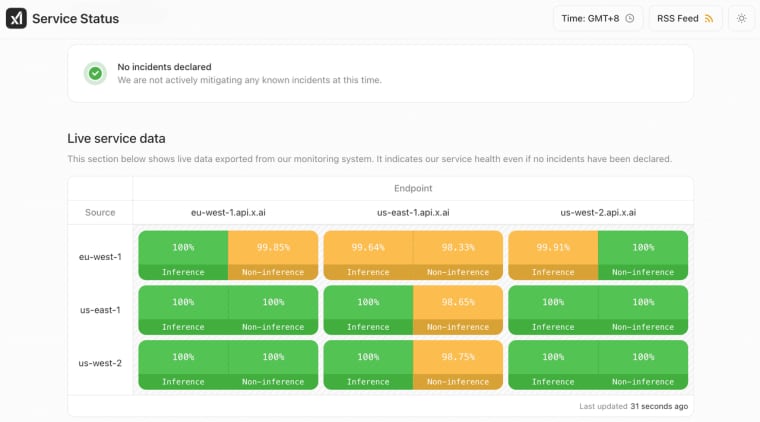
Credential handling is also serious. If a Bot signs into tools or works through existing accounts, founders need permission rules, revocation steps, audit notes, and human approval for consequential actions. xAI's service status surface can help with incident checks, but a customer-facing product still needs its own support path.
Service agreements, outcome ownership, refunds, and template rights are contract issues. This article is general information, not legal or contract advice. Actual handling should follow official policies, written customer agreements, and qualified professional review.
Make the Bot Job Visible Enough to Sell
A Grok Bot AI app becomes real when a background agent task turns into a customer journey with intake, status, review, correction, delivery, and saved results. Keep Grok Bot outside the promise until access and terms are verified, then build the visible product around the job users can understand and repeat.
Explore More Topics:
FAQ
Can a Grok Bot AI app use a custom domain?
Grok Bot itself should not be described as providing a customer-app custom domain unless xAI confirms that capability. A separate app layer may use a custom domain if the builder, hosting provider, or website platform supports it. Keep the Bot function and the customer-facing app layer separate in customer copy.
Should pilot customers receive a service agreement?
Yes, if the pilot involves paid work, private data, deliverables, refunds, or third-party agent use. The agreement can stay simple, but it should define scope, review responsibility, data handling, payment terms, and what happens if the background job fails.
Can agencies reuse the same intake template across client apps?
Usually yes in principle, but client-specific details, confidential examples, uploaded assets, and private instructions should not be reused without permission. Keep reusable structure separate from customer-owned context.
Who owns a workflow template created during paid setup?
Ownership depends on the contract. A paid setup may create reusable agency know-how, customer-specific templates, or shared improvements. Define this before onboarding so future reuse does not become a dispute.
How should the app handle refunds when a background job never finishes?
The app should define a failure state before launch. Options may include retry, manual completion, credit return, partial refund, or cancellation. The key is to make the refund rule visible before the customer pays.


