
A SaaS idea usually feels clearest before anyone uses it. The founder can see the dashboard, the pricing page, the clever workflow, maybe even the launch post. Then a real buyer asks one blunt question, and the whole thing gets more useful: "What problem does this solve for me this week?" I'm Elin.
I've watched more than one team spend months building the "full" dashboard only to discover the buyer never asked for it. The framework exists because the expensive mistakes almost always happen when a stage is skipped. That is the point of a SaaS creation framework. It slows the build just enough to make each stage earn the next one. Ideation, validation, MVP, launch, and growth are not decorative labels. They are checkpoints for evidence.
For the slug-level phrase, think of this as a practical saas creation framework stages ideation validation mvp launch growth path: define the buyer, test the problem, build the smallest workflow, launch to real users, then improve what repeats.
The Five SaaS Creation Stages at a Glance
| Stage | Question to answer | Minimum evidence | Exit condition |
| Ideation | Who has the problem, and why now? | Clear buyer, painful job, rejected alternatives | A narrow problem hypothesis |
| Validation | Will buyers act before the full product exists? | Interviews, manual delivery, presales, deposits, usage of a rough version | Evidence of demand |
| MVP | What is the smallest valuable workflow? | One core user, one action, one outcome | A working loop users can complete |
| Launch | Can strangers understand and use it? | Onboarding, support, distribution, feedback | Real usage beyond friendly testers |
| Growth | What repeats profitably? | Retention, unit economics, support capacity | A repeatable engine worth scaling |
A founder can move forward, pause, or move backward at any stage. That is not failure. It is how you avoid building a beautiful product around a weak assumption.
Ideation: Define the Problem and Buyer
Ideation is not "come up with ten app ideas." It is choosing one painful situation for one reachable buyer.
A strong SaaS idea names the customer, the job, the current workaround, and the cost of doing nothing. For example, "AI reporting software" is broad. "A weekly client-report builder for small marketing agencies that lose hours pulling data and rewriting status updates" is much easier to test.
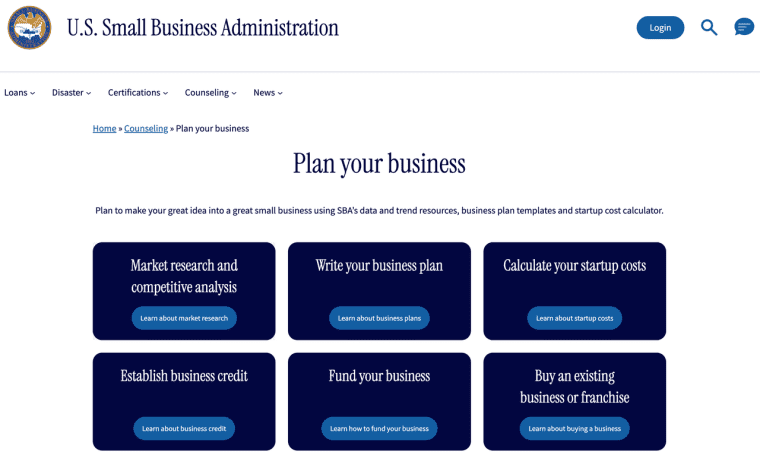
Good ideation also respects competition. The buyer is already solving the problem somehow: spreadsheet, freelancer, intern, email thread, generic SaaS, agency, or pure avoidance. Market research should look at demand, alternatives, pricing, and buyer behavior. The SBA's small-business guidance frames this well through customer demand, competitive research, and the search for market advantage.
Write the Problem Hypothesis and Exclusions
Write the idea as a problem hypothesis:
"For [buyer], who struggles with [job], because [constraint], this SaaS helps them [outcome] by [workflow]."
Then write exclusions. Exclusions are underrated. They protect the first version from becoming a museum of every possible feature.
Example exclusions: no enterprise SSO, no mobile app, no multi-language support, no custom reporting, no agency white-labeling, no advanced admin roles in v1. These may come later. They do not belong in the first proof.
Validation: Gather Evidence Before Building
Validation is where founders often want to cheat. It is tempting to treat excitement as evidence. "People liked the idea" is not enough. The real question is how to validate SaaS ideas before spending months on the wrong build.
Look for behavior: buyers agreeing to a call, sharing real examples, describing failed alternatives, paying for manual delivery, joining a pilot, signing a letter of intent, or using a rough tool more than once.
Interviews, Manual Delivery, and Commitment Signals
Interview buyers about the last time the problem happened. Not their general opinion. The last time. What triggered it? What did they try? Who was involved? What did it cost in time, money, risk, or embarrassment?
Manual delivery is powerful because it tests value before code. If the future SaaS will generate client reports, do five reports manually. If it will triage support requests, run the triage in a spreadsheet. If it will score vendor risk, do the scoring by hand and charge for it.
Commitment signals are stronger than compliments. A deposit, paid pilot, real data upload, calendar time from a decision maker, or internal champion is more meaningful than "looks cool." In buyer interviews for a client-report tool, most people described the exact same weekly pain—pulling data from multiple tools and rewriting status updates. Yet only a minority were willing to pay for a manual version first. The rest liked the idea but kept using spreadsheets. That gap forced the problem hypothesis to shrink.
MVP: Test the Smallest Valuable Workflow
The MVP stage is not where you build the mini version of your dream product. It is where you build an MVP around the smallest workflow that can prove value.
A clean mvp development process starts with one user, one input, one action, and one visible result. If the product needs ten workflows to make sense, it is probably not ready for an MVP. It is still an idea pile.
Scope the Core User, Action, and Outcome
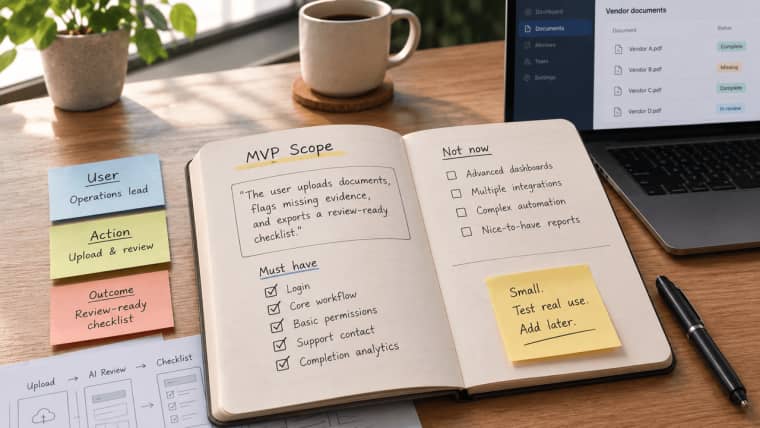
Define the MVP in one sentence:
"The user uploads X, reviews Y, and receives Z."
For a founder building a compliance tracker, that might be: "The operations lead uploads vendor documents, flags missing evidence, and exports a review-ready checklist." For a creator tool, it might be: "The marketer enters a product offer, generates three campaign angles, and saves the best one for review."
The MVP should include enough product layer to test reality: login if saved data matters, basic permissions if more than one role exists, support contact if failures are likely, and analytics for completion. It should not include every dashboard, integration, or automation the founder can imagine.
Launch: Put the Product in Front of Real Users
Launch is where the product leaves the founder's private logic and meets strangers. Strangers do not know the backstory. They need clear positioning, onboarding, pricing, support, and proof that the workflow is worth trying.
Do not launch only with a product link. Launch with a reason. Explain who it is for, what job it handles, what input it needs, what output it creates, and what the user should do first.
Onboarding, Support, Distribution, and Feedback
Onboarding should get the user to the first meaningful action quickly. If users cannot complete that action without a founder on a call, the product is not self-serve yet.
Support should be visible before it is needed. A small SaaS does not need enterprise support theatre, but users need to know where to report broken flows, confusing outputs, billing issues, and account problems.
Distribution should start narrow. Founder posts, partner lists, niche communities, comparison pages, and direct outreach can all work. SEO can help when the buyer already searches for the problem, but it should support the launch, not replace the founder's conversations.
Feedback should be tied to usage. Ask what users tried, where they stopped, what they expected, what they would pay for, and what they would use again.
Growth: Improve Retention and Repeatability
Growth is not just "get more users." It is finding what repeats without breaking the business.
A SaaS can get signups and still have no growth engine. Maybe users try it once and vanish. Maybe support costs are too high. Maybe the model cost is too unpredictable. Maybe customers like the output but will not pay for it monthly.
Usage Evidence, Unit Economics, and Operational Capacity
Look for retained usage, not just first sessions. Are users coming back weekly or monthly? Are they saving data? Inviting teammates? Exporting results? Paying again? Asking for improvements that match the core workflow?
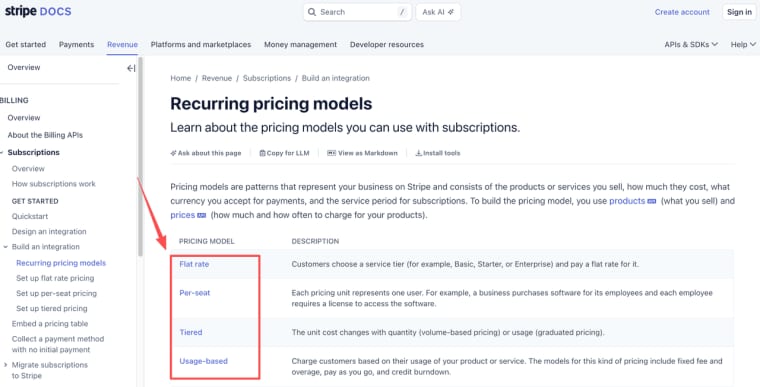
Unit economics should be checked early. Stripe's pricing model material is useful because flat-rate, per-seat, usage-based, and tiered pricing create different margin patterns. A founder should compare revenue against AI costs, infrastructure, support time, payment fees, refunds, and ongoing maintenance.
Operational capacity matters too. If every new customer creates five manual rescue tasks, the growth stage is telling you to fix the workflow before buying more traffic.
Stage Gates and When to Move Backward
Stage gates are decisions, not ceremonies. At the end of each stage, ask whether the evidence is strong enough to continue.
Move backward when the buyer changes, the problem is not painful, the MVP is too broad, launch feedback shows confusion, or growth exposes weak retention. The most mature founder move is sometimes to shrink the product.
A simple rule helps: if the evidence gets vague, move one stage back. If launch is failing, revisit validation. If validation is weak, revisit ideation. If growth is noisy, revisit the MVP workflow. One founder pushed paid ads while support tickets still required manual rescue for every new customer. Unit economics looked fine on paper until the support hours were counted. Growth only became repeatable after the workflow itself was fixed—another case of moving one stage backward instead of scaling a broken loop.
Where HappySeeds May Fit the Building Stage
HappySeeds may fit when the founder has passed basic validation and needs to turn one workflow into a testable app. This is the building stage, not a substitute for market proof.
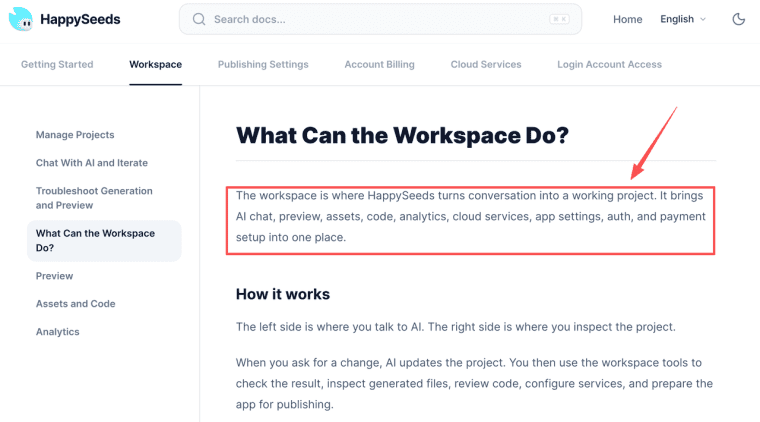
For example, a founder might already know that agencies want a recurring client-report workflow. The next question is whether users can log in, enter data, save records, review outputs, and complete the task without the founder doing everything manually. HappySeeds can be relevant because its workspace supports chat-based iteration, preview, assets, analytics, cloud services, app settings, auth, and payment setup in one build environment. If pricing or credits affect the MVP plan, check the current plans and credit model before committing launch budget.
The boundary is important. HappySeeds can help shape and ship an app workflow, but it does not validate demand, write positioning, solve distribution, guarantee retention, or remove the founder's responsibility for support and customer promises.
Limits and Trade-Offs
A framework can make decisions clearer, but it cannot remove uncertainty. Founders still face trade-offs: speed versus evidence, narrow scope versus investor ambition, automation versus support quality, and growth experiments versus product focus.
Legal and company setup questions also sit outside this framework. Co-founder agreements, incorporation timing, investor materials, equity, taxes, privacy, and regulated workflows depend on jurisdiction, contracts, and professional advice. Treat this article as operational guidance, not legal, tax, corporate, or investment advice.
Let the Evidence Earn the Next Stage
A SaaS creation framework is useful because it keeps ambition attached to proof. Start with a specific buyer, validate the pain, build the smallest workflow, launch with support, and grow only what repeats. The product gets stronger when each stage answers the question in front of it instead of rushing toward the version in your head.
Explore More Topics:
FAQ
When should founders create an investor deck in the SaaS creation framework?
Create one only after Validation or early Launch shows real evidence—deposits, paid pilots, or repeated usage—not just because the product has a name. The deck should honestly state the current stage and what still needs proof.
Does a SaaS project need a cofounder agreement before moving past Ideation?
Yes, if more than one person is contributing meaningful work, code, customers, or equity expectations. Unclear ownership can block honest stage decisions later. Handle details with legal help.
At which stage of the SaaS creation framework should a company be incorporated?
Often around late Validation or early MVP—before taking payment, signing contracts, or handling riskier data. Some wait until Launch shows real usage. Timing depends on jurisdiction and risk.
How should a pivot change existing product analytics?
A pivot should reset how the team reads the numbers. Old traffic, usage, and conversion data may not reflect the new buyer or job. Keep historical data, but label the pivot date clearly so future decisions do not mix two different products.
When is closing a SaaS project the right decision?
Closing can be right when the problem is not painful enough, users do not return, support costs overwhelm revenue, the founder no longer trusts the market, or a better opportunity has stronger evidence. A clean shutdown should include customer notice, data handling, billing closure, and support for active users.


