
The first question a founder should ask about Ornith-1.0 is not whether it looks impressive in a benchmark thread. The better question is whether there is enough verified public information to trust it inside a commercial app stack.
That distinction matters. A coding model can be interesting for experiments, prototypes, and local development tests. But a paid app needs more than code generation. It needs clear licensing, stable access, security review, maintenance signals, product logic, user flows, payments, analytics, and support.
I'm Elin. So this article takes a conservative angle. Ornith-1.0 may be worth watching as an open coding model, but founders should treat it as an experimental candidate until they have reviewed the official release source, model card, license, runtime requirements, and production fit for their exact use case.
Should Founders Build Around Ornith-1.0?
Founders should not build around Ornith-1.0 commercially until they have reviewed its official release page, Hugging Face model card, license, usage terms, runtime requirements, benchmark scope, and maintenance path. That does not mean the model is useless. It means the model should be treated as an experimental candidate until the team has verified the commercial and operational questions for its own stack. A non-technical founder should especially avoid confusing model novelty with app readiness.
If you want to build AI app workflows for real users, you need product reliability, user accounts, saved data, payments, support, SEO, and iteration. A model can help write code. It does not create a business.
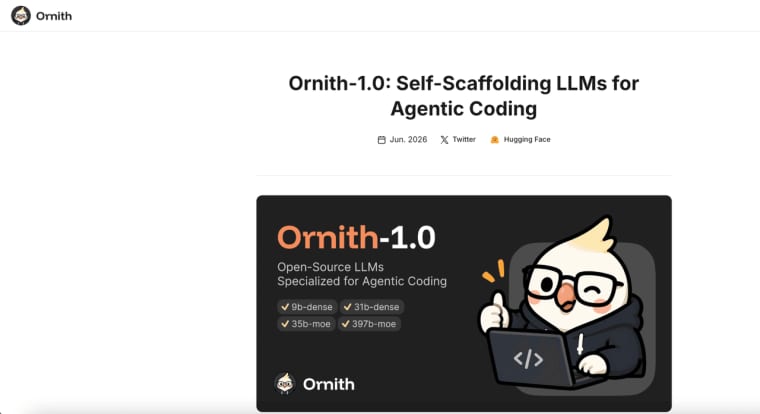
The real question is commercial app readiness, not model novelty
A founder needs to know whether Ornith-1.0 can be used legally, maintained safely, monitored in production, and replaced if something breaks. Open-source does not automatically make it safe for commercial use. The Open Source Initiative's explanation of what open source requires is a useful reminder that a name or download link is not enough. The actual license terms matter.
The better question is not "Is Ornith-1.0 new?" It is "Can I responsibly depend on it inside a product users pay for?"
What an Open Coding Model Can Help With
An open coding model can still be useful before it becomes part of the production stack. It may help founders and builders generate small features, clean up prototypes, explore implementation options, write tests, explain code, or run local experiments. A local LLM can also be useful when a team wants more control over where code and prompts are processed.
Code generation, fixes, local experiments, and prototype cleanup
A coding model can help reduce friction during early building. It may draft functions, suggest refactors, explain errors, or turn a rough idea into scaffolded code. For a technical founder, that can speed up iteration. For a non-technical founder, it can help create a demo or communicate more clearly with a developer.
Local experiments may also be attractive. A local model can let a team test prompts, evaluate code behavior, and explore private workflows without sending every request to a hosted provider.
But none of this proves commercial readiness. Prototype cleanup is not the same as production maintenance. A model-generated feature still needs review, tests, deployment, security checks, and user feedback.
What Ornith-1.0 Does Not Make Commercially Ready
Ornith-1.0, or any open-source coding model, does not automatically create the parts of an app users experience. A paid app needs more than generated code. It needs a system that helps users complete a valuable workflow again and again.
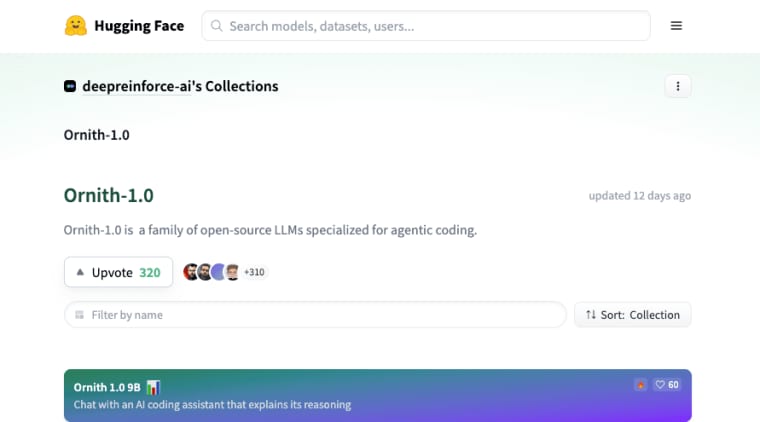
User accounts, saved data, payments, permissions, SEO, analytics, support, and retention
Commercial readiness starts with product layers. User accounts let people return. Saved data lets work persist. Payments test willingness to pay. Permissions matter when teams or clients use the app. SEO helps cold users understand and discover the product. Analytics show whether people activate, return, and convert. Support workflows help when users get stuck.
A coding model may help build those features faster, but the founder still has to decide what they do, who they serve, and how they will be maintained. This is where an AI app builder can be different from a model. The model helps produce code. The app builder should help structure the product.
The Demo-to-Paid-App Gap
The demo-to-paid-app gap is where many AI tools become painful. A demo can work once. A paid app has to work repeatedly for strangers who bring messy data, make mistakes, ask for refunds, and expect support. That gap is not solved by model quality alone.
Reliability, onboarding, deployment, billing, support workflows, and user feedback loops
Reliability means the app behaves predictably enough for users to trust it. Onboarding means users understand what to do without a founder explaining the product in a call. Deployment means the app is available when users need it. Billing means payments, credits, cancellations, and failed charges are handled cleanly.
Support workflows matter because model-generated code can introduce confusing bugs. If a user reports a broken workflow, someone has to know whether the issue came from the model, the prompt, the app logic, the database, the deployment, or the user's input.
Feedback loops are the final piece. A founder should track which features users repeat, where they drop off, what support tickets appear, and whether the product gets better over time.
A model can generate code. It cannot listen to users for you.
Commercial Readiness Checklist
Before using Ornith-1.0 in a commercial stack, founders should run a readiness check. This is not bureaucracy. It is the difference between a fun local test and a product users can rely on.
Access rights, license, maintenance owner, model quality, security review, fallback plan, and cost path
| Area | Founder question |
| Access rights | Is the official source verified, and are the weights actually available? |
| License | Does the license allow the intended commercial use? |
| Maintenance owner | Who updates, monitors, and replaces the model if needed? |
| Model quality | Does it pass real tasks from your app, not only public benchmarks? |
| Security review | Has generated code been reviewed for unsafe patterns? |
| Fallback plan | What happens if output quality drops or the model becomes unavailable? |
| Cost path | What are the real costs for local hardware, hosting, monitoring, and support? |
For model publishing norms, Hugging Face's guidance on model cards is useful because it shows the kind of information serious users should expect: model details, intended use, limitations, training data, evaluation, and risks.
Security also needs its own check. The OWASP project on top risks for LLM applications is a good reference for thinking beyond "the model answered correctly."
When Founders Should Not Use It Yet
There are times when founders should keep Ornith-1.0 out of the commercial product, even if it looks promising. A model can be useful internally before it is safe enough to depend on publicly.
Unclear licensing, unstable outputs, no maintenance plan, or no real user workflow
Do not use it yet if the license is unclear. Do not use a model yet if you cannot verify the release source you plan to depend on. Do not use it yet if outputs are unstable and nobody knows how to measure quality. Do not use it yet if the team has no maintenance owner. Also, do not use it yet if there is no real user workflow.
That last point matters. A founder may get excited about a coding model and start building features before proving that users care. That is backward. The app should start from a user job, not from model availability.
If Ornith-1.0 is useful, let it help with internal prototyping first. Keep local tests internal until quality, legal rights, security, maintenance, and business value are clear.
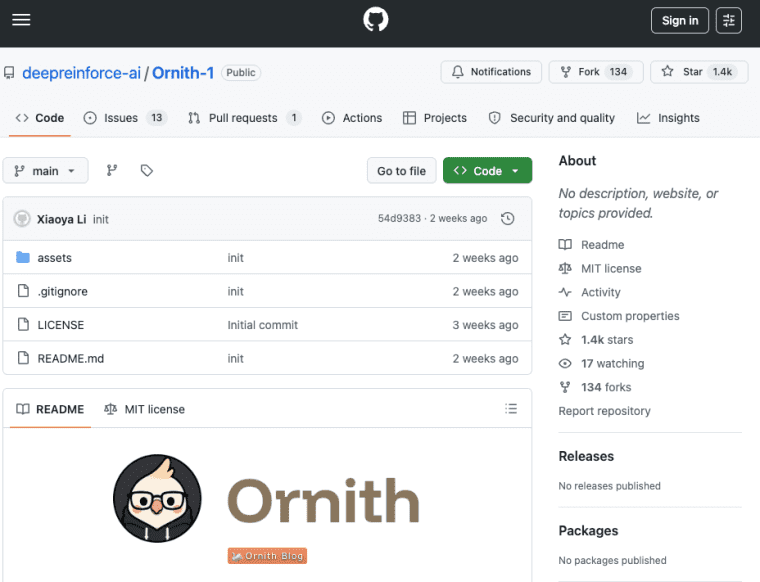
As of July 9, 2026, Ornith-1.0 has publicly available official sources, including the DeepReinforce blog and Hugging Face model cards. However, for any open coding model, teams should still carefully verify the source, license, weights, context limits, hardware requirements, commercial restrictions, benchmarks, and long-term maintenance plans before using it in production or recommending it as a Claude Code alternative.
Explore More Topics:
FAQ
Who owns maintenance after model updates?
Maintenance should have a named owner before launch. That owner may be a developer, technical partner, agency, or internal engineering lead. The job includes tracking model changes, reviewing generated code, updating prompts, checking regressions, and deciding when to roll back. If nobody owns maintenance, the model should not be part of a paid app stack.
How should founders plan version migration?
Version migration should start with a baseline. Save known tasks, expected outputs, failure examples, and user-impact notes. When a new model version appears, run it against the same tasks before switching. If it changes code style, dependencies, latency, or bug patterns, migrate gradually instead of replacing the model everywhere at once.
When should local model tests stay internal?
Local model tests should stay internal when licensing is unclear, quality is unstable, security review is incomplete, or the workflow has not been validated with users. Internal testing is useful for learning. Public launch requires stronger evidence that the model, app, and support process can handle real user behavior.
What support burden can open models create?
Open models can create support burden when generated code is hard to debug, outputs change after updates, local hardware fails, dependencies drift, or users report issues the founder cannot reproduce. The app may also need documentation explaining limitations, fallback behavior, and what support will or will not fix.
How can updates affect an existing app?
Model updates can change code suggestions, error patterns, dependency choices, security behavior, and output consistency. Even a better model can break an existing workflow if the app depends on old behavior. Founders should keep logs, tests, rollback paths, and user-facing release notes, so updates feel controlled instead of surprising.


