I broke a production app the week the group stage kicked off. Nothing dramatic — I'd hardcoded a match list, the bracket shifted, and suddenly my little "who plays next" page was showing a fixture that had already happened. That's the thing nobody tells you about building around a live tournament: the fifa world cup schedule isn't a static file you ship once. It moves under you. And right now, with the group stage closing on June 27 and knockouts starting June 28, it's moving fast.
Elin here. So this post isn't about building a pretty pre-tournament planner. That window closed. This is about what people actually need during the World Cup — and whether that need is enough to build a real product on. I'll walk through what I'd build now, what data headaches you'll hit, and what to validate before the final on July 19. There's also a demo at the end I want to show you, but it's not what you'd expect.
Why Schedule Search Is a Strong Product Signal During the World Cup
Here's what I got wrong on my first build: I assumed schedule searches peak before kickoff. They don't. They peak right now, as the Round of 32 bracket takes shape and fans struggle to keep track of the 32 advancing teams. Retrieval pipelines map to the Codex R2R setup.
Think about it from a fan's side. The world cup 2026 group stage produced chaos — the expanded 48-team format means the top two from each of 12 groups, plus the eight best third-placed teams, all advance to a brand-new Round of 32. According to FIFA's own structure, the total number of matches jumped from 64 to 104, and the tournament runs 39 days. That's a lot of fixtures for a casual fan to track. Every time a group finalizes, a wave of people search "who does [team] play next."
That search behavior is the product signal. People aren't browsing — they have a specific, repeating question. And repeating questions are where small tools quietly earn their keep.
What a FIFA Schedule AI App Should Do Now
Forget the full-season planner. The in-tournament version of a fifa world cup 2026 schedule tool needs to answer "what's relevant to me in the next 48 hours." That's a narrower, more useful job.
Knockout bracket, favorite teams, reminders, venues, and languages
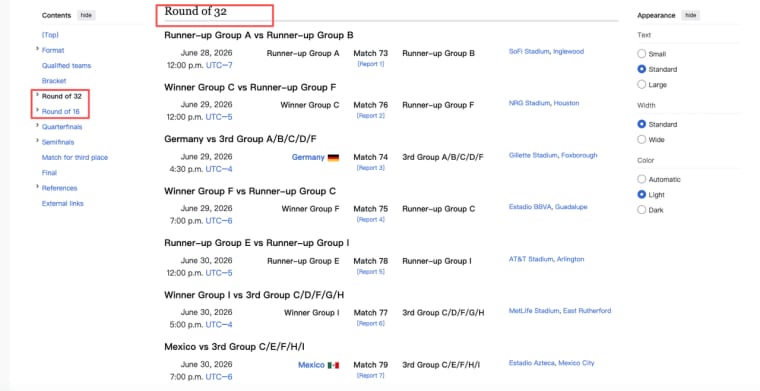
- A live knockout bracket. This is the heart of it. The bracket fills in as results come in, and the path is structurally locked even before teams are known — Round of 32 (June 28–July 3), Round of 16 (July 4–7), quarterfinals (July 9–11), semis (July 14–15), third place (July 18), final (July 19). The dates don't move; the names do.
- Favorite teams. Let someone follow Argentina or the USMNT and only see their next match. Most fans care about two or three teams, not all 48.
- Match reminders with time-zone handling. This is the feature that separates a useful tool from a static page. A match at 3 p.m. ET means something completely different to someone in Tokyo. If your match reminders don't convert kickoff times to the user's local zone, they're worse than useless.
- Venue and city info. Sixteen host cities across three countries. Someone deciding whether to travel — or just which broadcast window to plan dinner around — wants this.
- Languages. I nearly shipped an English-only version and caught myself. The fan base for this tournament is global. Spanish-language users alone represent an enormous share of World Cup search traffic across the Americas. If you're building for reach, a language toggle isn't a stretch goal.
The discipline here is restraint. The tools that fail try to be a full sports portal. The ones that stick answer one question well.
From Schedule Search to a Real Product
A schedule view is a feature, not a business. The jump to product happens when you add things people will return for — or pay for.
Data sources, user accounts, notifications, and monetization
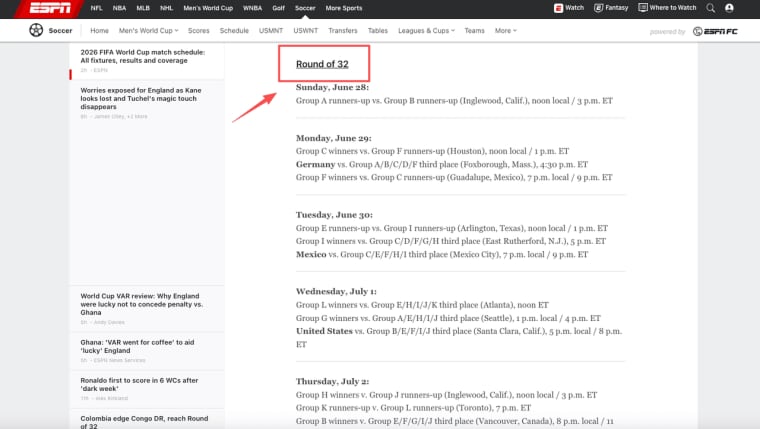
The honest order of operations: data first, accounts second, notifications third, monetization last. You need a reliable fixture source before anything else. FIFA publishes the official knockout stage bracket and match schedule, and that's your anchor of truth — not a scraped third-party page that might lag. Cross-referencing against a major outlet's live fixtures, like ESPN's match schedule, helps you catch venue or time changes quickly.
Then user accounts, so favorites and reminder preferences persist. Then notifications — and this is where I'd be careful. Push notifications around live sports are a legal and policy minefield. You can remind someone a match starts; you should not imply you're delivering authorized live scores, odds, or anything resembling betting or prediction accuracy. That's a line worth respecting, not testing.
Monetization, if it comes, is gentle: a "pro" tier with unlimited team follows or calendar export, a sponsored newsletter, an affiliate link to legitimate viewing options. Nothing aggressive. The audience is here for four weeks — earn trust, don't burn it.
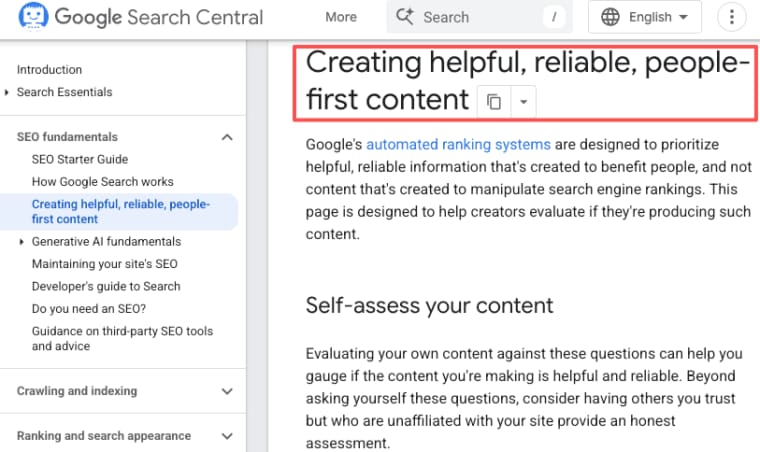
This is also roughly where an AI app builder earns its place. The reason I bring it up: the bottleneck for most non-technical founders isn't the idea, it's wiring up accounts, a database, reminder logic, and a domain before the tournament ends. Tools in this space — covered well in Google Search Central's helpful content guidance, which rewards genuinely useful, experience-backed tools — compress that build time from weeks to an afternoon. Whether that's worth it depends on your timeline, and your timeline here is brutally short.
What Founders Should Validate Before July 19
Quick reality check: the tournament ends July 19. Anything you build now has a four-week shelf life unless it's designed to outlast the event. Before sinking time in, I'd validate:
- Does anyone actually use it twice? A schedule tool people check once is a Google search with extra steps. Return visits are the only signal that matters.
- Can you get fixture data legally and reliably? Match data, broadcast info, and venue details carry rights restrictions. Confirm what you're allowed to display — don't assume.
- Do reminders convert? If you ship notifications and nobody opts in, that "feature" was a distraction.
- Is there a path past the final? The teams that build something lasting treat the World Cup as a launchpad for an "event reminder" or "fan assistant" tool that works for the next tournament too.
Honestly? Most schedule apps shouldn't become products. But the ones that nail reminders and a clean bracket for one specific audience — say, expat fans tracking matches across time zones — have a real shot.
A demo I want to show you (it's not a schedule app)
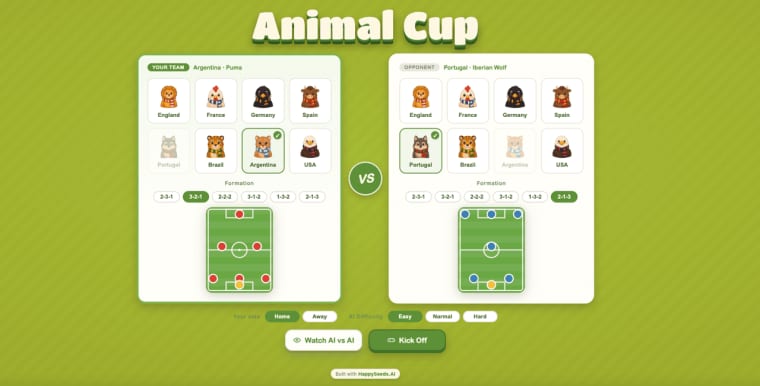
Here's the plot twist. The community built a World Cup demo on HappySeeds, and it's not a schedule tool at all — it's Animal Cup, a tiny AI-powered football simulator where you pick an animal-mascot national team, choose a formation, and watch a full 6v6 match play out. Argentina's a puma, Portugal's an Iberian wolf. It's silly and I lost twenty minutes to it.
If you're sitting on a fan-tool idea right now, that speed is the whole game. The schedule isn't going to wait for you.
Stop planning the perfect fan app and ship the rough one before the bracket empties out. If you want a concrete reference for what "shipped during the tournament" looks like, Animal Cup is a working demo built on HappySeeds — an AI-powered match simulator with real national teams, animal mascots, live stats, and a language toggle, put together as a template for exactly this kind of time-sensitive idea. It's not a schedule tool, but it shows what the platform can turn around before a window closes. Clone the concept, strip the animals, build the version only you can see.
Explore More Topics:
- Build a FIFA 2026 AI App: Turning Search Demand into a Product
- Loop Engineering for AI App Founders: Build, Measure, Learn Faster
- Claude Artifacts vs AI App Builders: Choosing the Right Container
- Vercel + Supabase for AI Apps: What Founders Still Need to Plan
- Minerva AI and the Opportunity in Vertical AI Apps
FAQ
How important are time-zone reminders in a schedule app?
For an international audience, they're the difference between useful and ignored. A kickoff listed only in ET is meaningless to a fan in London or Tokyo. If you build reminders, local-time conversion isn't a nice-to-have — it's the core of the feature.
What should builders consider before adding notifications or live updates?
Tread carefully. Reminding users that a match is about to start is fine; implying authorized live scores, odds, or betting/prediction content is not, and may carry rights and policy restrictions. Always verify what match and broadcast data you're permitted to display against official sources before shipping.
How can founders validate whether a schedule app can become a paid product?
Look for return usage and willingness to opt into something — reminders, a newsletter, saved favorites. A tool people check once isn't a product. And build with a post-July-19 life in mind, or you're shipping something with a four-week expiry.
What data challenges come up when building tournament schedule apps?
The fixtures aren't static — venues, times, and bracket slots update as results land, so a hardcoded list goes stale fast. Match and venue data also carry rights restrictions. Anchor to official FIFA fixtures and confirm usage permissions rather than relying on scraped or third-party data. Always check the latest official documentation before relying on any specific detail.
Is it worth building a World Cup tool that only lasts until July 19?
Yes, if you design with a successor in mind. The fixture-tracking problem doesn't go away after the final; it shifts to domestic leagues, continental cups, and the next major tournament. A "World Cup schedule tool" that actually works can become an "event reminder for football fans" with a longer shelf life. The ones that shouldn't exist are the ones built only for this tournament with no thought to what comes next — those are campaigns, not products.