When you start looking at Adalo, there's one important thing that rarely gets mentioned upfront: the question isn't really whether Adalo works. It mostly does, for what it's built for. The real question is whether the thing you're trying to ship matches what Adalo is best at. Most solo founders (myself included) spend the first 2-3 weeks building something, only to realize they chose the wrong tool category. They wanted a commercial product that people can find, pay for, and use — but they picked a native mobile builder optimized for App Store downloads.
I know because I was one of them — 26, three weeks in, and convinced I needed a mobile builder. I didn't. I clicked through a bunch of other no-code platforms this month, partly to procrastinate on my own build, partly because I needed clarity. This post is the version of that research I wish I'd had on day one.
Is Adalo Still the Right Fit for Your App Idea?
Short answer: maybe. Longer answer: depends on what "live app" means to you.
If you imagine your end state as a thing in the App Store with your icon on someone's home screen — Adalo is good at that. If you imagine it as a working AI tool with a custom domain, a paywall, and traffic from Google — that's a different problem, and a different category of builder. User management is covered in Kinde with Codex.
Most founders I talk to don't know which one they want until they're three weeks in. So before we get into the picks, let me save you that detour.
What Adalo Is
No-code mobile app builder basics
Adalo is a no-code mobile app builder that compiles to native iOS and Android, plus a web version, from a single visual canvas. You drag screens around, hook them up to a built-in database, add components, and publish. The current generation — Adalo 3.0, shipped in November 2025 — overhauled the backend infrastructure for stability and performance. Multiple long-time users on Capterra confirm apps got noticeably faster after the upgrade, though the platform still sits at a modest 3.4/5 based on 23 verified Capterra reviews — worth knowing the distribution isn't all glowing.
On the compilation chain itself: Adalo generates true native binaries (IPA for iOS, APK for Android) — not WebView wrappers running web code inside a phone shell. According to Adalo's official performance benchmark page (March 2026), post-3.0 average API latency is 165.92ms, uptime was 99.11% between January–March 2026, and the platform handles 20M+ daily data requests. The official caveat: performance may drop noticeably past 50–100 concurrent users at a single moment — different from total user count.
The database is a separate consideration. It's the built-in backend, not the compilation chain, that has a practical ceiling: Adalo loads datasets into memory client-side before filtering, so list views start slowing down as record counts grow. Multiple independent reviewers on G2 report friction past a few thousand users when using the built-in database without optimization. For apps expecting significant data volume or user growth, Adalo's own docs recommend integrating an external database like Xano or Airtable via External Collections — which adds cost and setup. Worth planning for before you build, not after.
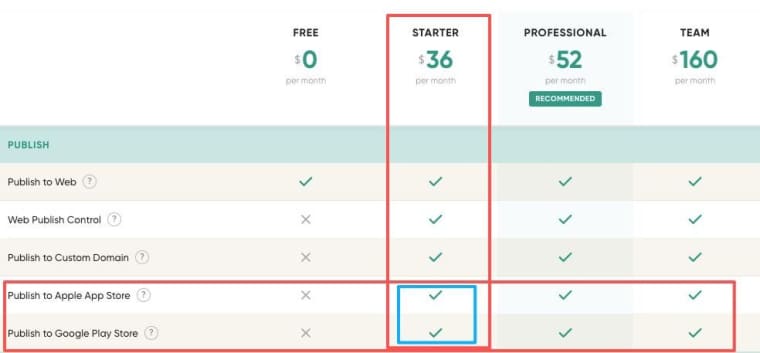
Here's the pricing reality that caught me off guard. The tiers gate where and how you're allowed to launch — and the gap between "I built it" and "I can charge for it" is bigger than the entry price suggests. The matrix below was compiled from Adalo's official pricing page (checked May 2026) cross-referenced with third-party 2026 breakdowns where the official page was ambiguous:
| Plan | Price (annual) | What you can actually do |
| Free | $0 | Build and test only. No publishing to web or app stores. |
| Starter | $36/mo | 1 published app, custom domain, removes Adalo branding. Web/PWA publishing. |
| Professional | $65/mo | 2 apps, iOS + Android store publishing, API access, custom integrations, geolocation. |
| Team | $160/mo | Stripe payment processing, Collections API, Custom Actions. |
| Business | $250/mo | 10 published apps, more editors. |
Tiers have changed more than once. Verify against the official page before committing — what's accurate in May 2026 may not be in November.
The detail that trips up the most founders, per CheckThat.ai's 2026 pricing breakdown: Stripe payment processing only unlocks on the Team tier ($160/mo annual), not the entry plan. So if your MVP is meant to make money on day one, your real starting cost isn't $36 — it's closer to $160/mo plus app store fees. Worth knowing before you fall in love with the canvas.
They also rolled out an AI feature suite called Ada — the headline function, Magic Start, lets you describe an app in plain language and generates a starting database and screen flow. I tested this directly, with the following setup:
- Platform: Adalo Free plan (browser, Chrome 124, macOS)
- Test date: Mid-May 2026
- Prompt type: Single-sentence plain English (no technical vocabulary, no database schema specified)
- Measurement: Time from submit to first clickable preview; structure accuracy vs. intended design
My exact prompt: "a journaling app for indie makers who keep abandoning projects."
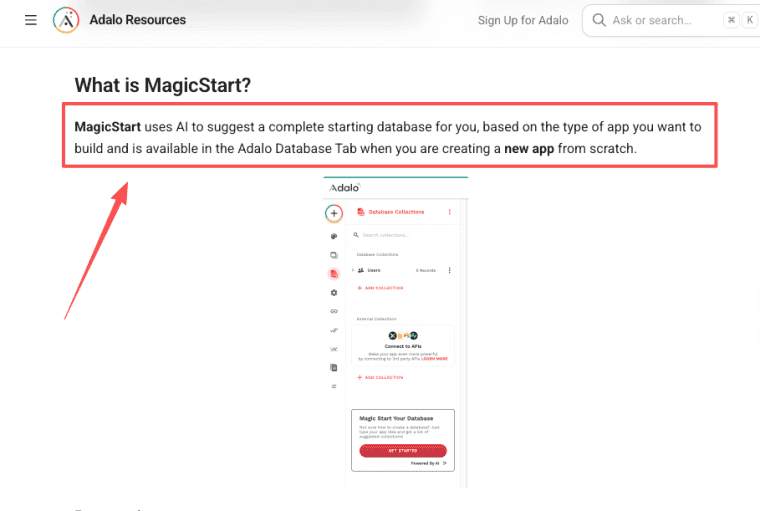
Result: About 2 minutes from submit to clickable preview. The generated scaffold included:
- A 3-table database: Entries (body, date, mood, linked project), Projects (name, status, abandoned_at), Mood Tags
- A logged-in home screen with an entries feed
- A working "new entry" form with auto-filled date
- A profile screen with project list
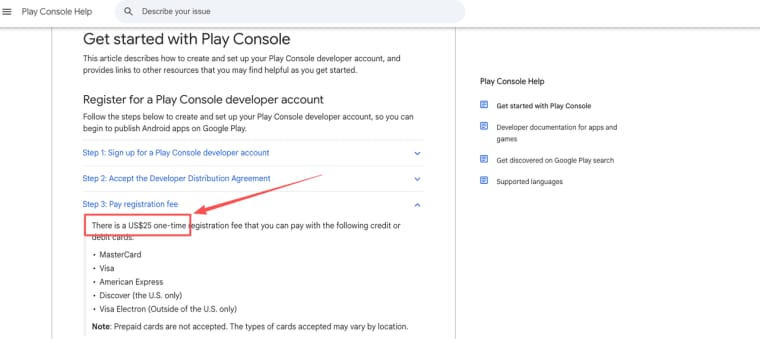
To actually ship to the stores, you still need an Apple Developer Program membership ($99/year) and a Google Play Console account ($25 one-time). These aren't Adalo costs — they're Apple and Google charging you for the privilege of distribution. Every native app builder has the same line item.
Where Adalo Works Well for Founders
Mobile-first MVPs
If your idea is fundamentally a mobile app — the experience makes no sense outside a phone — Adalo is one of the cleaner ways to get there without a developer. Booking apps. Community apps. Habit trackers. Things people install once and open daily. The reason it matters: Adalo compiles to actual native builds, while a lot of "build a mobile app" platforms quietly produce web wrappers.
Simple database-backed apps
The second sweet spot is anything where the core loop is user logs in → sees a list → taps an item → does a thing. Directories, internal team tools, simple marketplaces, event apps. Adalo's database and component library handle that pattern well, and you don't need to wire anything together yourself.
Where it gets less fun is when your app starts wanting to do something AI-shaped — generate text, respond to user inputs, pull insights from uploaded files. You can wire external APIs through Custom Actions and Zapier, but the experience is much more "I'm gluing pipes" than "the platform speaks AI natively." Worth knowing before you start.
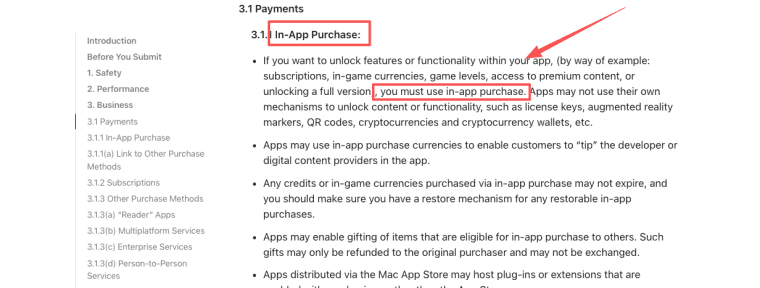
One more thing if monetization is on your roadmap: payment-related features sit on higher tiers in some cases, and iOS native apps have Apple's In-App Purchases rules for digital goods. Check the plan matrix carefully.
When Founders Need a Commercial App Platform — An App Builder for Founders Beyond Mobile
This is the part I want to be careful about, because it's where most comparison articles get lazy and just list ten competitors side by side. The real fork isn't Adalo vs one rival — it's two whole categories that happen to look similar from the outside:
| Native mobile builders | Commercial app platforms | |
| Examples | Adalo, Glide, FlutterFlow, Draftbit | Bubble, HappySeeds, similar |
| Output | Installable iOS / Android app | Hosted web app at your domain |
| Distribution | App Store + Google Play | Google search, links, referrals |
| Payments | App store IAP / Stripe on higher tiers | Built-in web checkout |
| Best when | Daily-use, install-once apps | Find-pay-use-in-one-session tools |
| Job ends at | App is in the store | Launch, then keeps iterating |
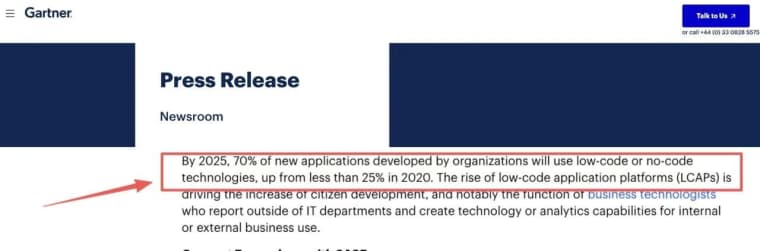
Gartner's 2021 forecast — that by 2025, 70% of new applications would embed low-code or no-code, up from less than 25% in 2020 — has largely been borne out, and the curve hasn't stopped. But the platforms themselves are splitting into specialties. "No-code" used to mean one thing. Now it means at least four.
A useful question: when I imagine my first paying user, are they finding me through the App Store, or through a Google search, a newsletter link, a referral from someone who already paid? If it's the second one — almost always — a native mobile builder may be solving a problem you don't actually have yet.
That's where HappySeeds fits in. Not as a replacement for native mobile publishing. As a different category: an app builder for founders whose first user finds them online, not in an app store.
To be clear about the boundary: if your dream is genuinely a downloadable iOS app, HappySeeds isn't the answer and I'd point you back to Adalo or FlutterFlow. But "mobile app" became most founders' default phrasing for "the thing I want to build" — and a lot of those ideas are actually web apps in disguise.
The question I keep coming back to: what's the shortest path from your idea to someone paying you? Sometimes it's the App Store. Often it isn't.
A quick checklist before you commit to any builder
Run your idea through these five before you pay for a year of anything:
- Where do my users live? App Store, web, or both. Be honest about how the first 100 will actually arrive.
- What does monetization require? Find the exact tier that unlocks payments — not the advertised entry price. (For Adalo, that's Team at $160/mo.)
- What's the path from prototype to paying user? Not idea to demo. The demo is the easy part.
- Can I keep iterating after launch without a developer? Or do I hit a wall the moment I want something custom?
- What's the real total cost? Platform fee + app store fees + payment processing, for year one. Write the number down.
Most comparison posts skip number three, which is usually the one that matters most.
Last note: I still haven't fully launched mine. But I picked a platform yesterday — turned out the right Adalo alternative for me wasn't another mobile builder at all. That's a start. Honestly, that's most of it.
FAQ
What is Adalo?
Adalo is a no-code mobile app builder founded in 2018. The thing the marketing pages don't make obvious: it compiles to true native iOS and Android binaries (IPA and APK files), not a web wrapper inside a phone shell. That's a meaningful distinction in 2026 because a lot of competing builders still produce wrappers and don't say so. It also has a built-in relational database (no SQL needed), a component library with push notifications and geolocation, and an AI feature suite called Ada (with Magic Start that turns a plain-English description into a starting database plus screen flow).
How do founders usually use Adalo for mobile app building?
Honestly? The pattern I keep seeing: spend the first weekend on Magic Start to get a rough scaffold, then spend two weeks reshaping the database and screens into what you actually wanted (the AI's first guess is rarely right). Most founders budget around $36/month for Starter, plus $99/year for Apple Developer, plus $25 one-time for Google Play — roughly $560 for year one before payment processing. Where founders get stuck isn't the building — it's the App Store review. First submissions get rejected for missing privacy policies, broken sign-in flows, or thin functionality. Budget two to three rejection cycles into your timeline.
What should non-technical founders evaluate when comparing Adalo alternatives?
Five things, in order: (1) does the platform's output match where your users actually live — App Store, web, or both; (2) does it handle the commercial layer you need — payments, custom domain, SEO, real data; (3) what's the path from prototype to paying user, not from idea to demo; (4) can you keep iterating after launch without a developer; (5) the real total cost — platform fee plus app store fees plus payment processing. Most comparison posts skip number three, which is usually the one that matters most.
When should founders consider moving beyond Adalo for a commercial launch?
A few concrete signals: (1) you've built your prototype and realized your "users" all live in browser tabs, not on phones; (2) you want to publish app without coding and skip the App Store review queue, which can run days and sometimes rejects you for reasons unrelated to your product; (3) your idea has a real AI component and you're already gluing it together with Zapier and Make. Any one of those is a tap on the shoulder. Two of them and the answer is probably yes.
What is the difference between native mobile builders and full commercial app platforms?
The cleanest test isn't technical — it's distribution. Native mobile builders bet on app store discoverability and the home-screen icon. Commercial app platforms bet on search, link-sharing, and embedded payments — tools people land on through Google, get value from immediately, and pay for in the same session. Same skill set, completely different bets on how strangers find you. The trap I see most often: founders pick the category based on what their idea feels like ("it's an app, so I need a mobile builder") instead of how their first 100 users will realistically arrive.