Here's the part that nobody told me upfront: the moment something pops up on screen, your brain treats it like a finished product. It's not. And if you're trying to actually charge users for it — not just take screenshots and tweet about it — you'll hit a wall sooner than you think. This post is for anyone searching for a Create.xyz alternative because they hit that same wall. I'll walk through what Create.xyz actually is, where it breaks down once you stop prototyping, and what to look for if your goal is a live app you can monetize.
I'm Elin, 26. I've broken three production apps in the last six months, two of them my own. This post is what I learned the second time. So when a tool promises "describe your app and watch it appear," I click before I think. That's how I ended up spending three weekends inside Create.xyz (which, by the way, quietly rebranded to Anything in August 2025 — more on that mess in a second).
When an AI-Generated Page Is Not Enough
I remember the exact moment my prototype stopped feeling like a product.
I'd built this little tool — a journaling app that auto-tagged entries with mood and topic. Looked great. Worked great when I was the only user. Then I sent it to a friend, asked her to try it, and she replied: "It logged me in as you." Windsurf users can wire this up via the Codex Windsurf integration. Cool. Cool cool cool.
That's the gap I want to talk about. AI builders are extremely good at producing the visible layer of an app — the buttons, the pages, the animations. They're noticeably less good at the boring stuff underneath: real authentication, persistent data per user, payment flows that handle refunds, SEO that actually gets indexed. And the problem is, you usually don't know which layer broke until a real human is on the other side trying to use the thing.
If your end goal is a tweet that says "look at this cool thing I made" — you're fine. Most AI website builders will get you there in an hour. But if the goal is "someone pays me money for using this" — the requirements quietly multiply.
What Create.xyz Is
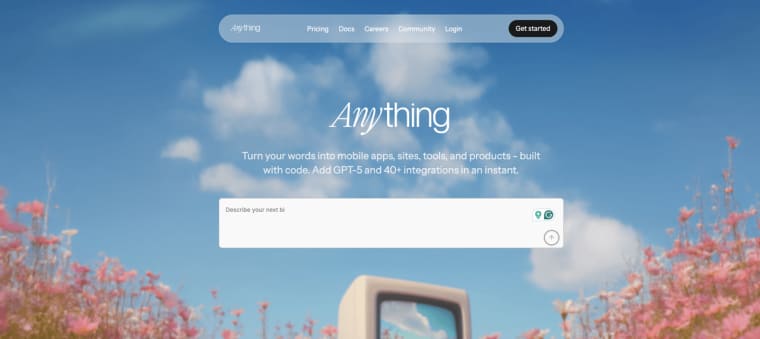
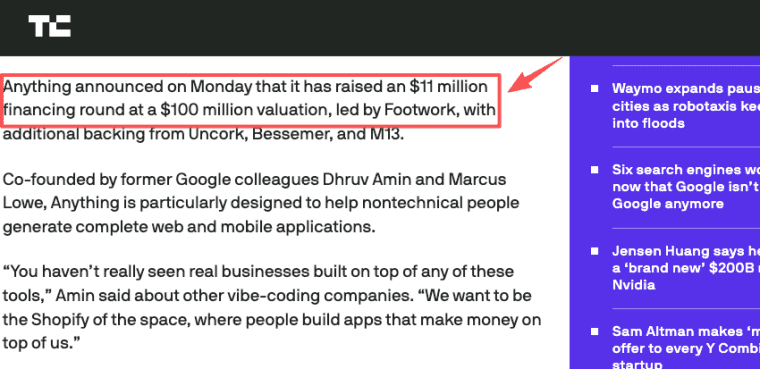
Create.xyz, now operating as Anything, is an AI app builder that turns natural-language prompts into web apps, with backend, database, auth, and integrations bundled in. Co-founded by Dhruv Amin and Marcus Lowe (now co-CEOs), with Mark Craemer also listed as a co-founder. Total funding sits around $19.5M — most recently an $11M Series A led by Footwork in September 2025 at a $100M valuation, per TechCrunch. Pricing as of May 2026 runs from a one-time 3,000-credit free allotment to Pro 20k at $19/month annual, $24/month monthly— verify current tiers at anything.com/pricing before committing, since SaaS pricing changes faster than blog posts.
The pitch is straightforward: describe the app, get an app. And to be fair, the first 80% is genuinely impressive. You can spin up a workable internal tool or a content generator over a single coffee.
AI website builder vs AI app builder
Here's a distinction that matters more than the marketing copy admits.
An AI website builder generates pages — landing pages, portfolios, marketing sites, documentation. Static content, mostly. Beautiful, fast, low risk.
An AI app builder generates applications — things with users, accounts, data that persists between sessions, logic that fires when someone clicks a button. Much higher complexity. Much higher chance something breaks under real-world use.
Create.xyz sits awkwardly between the two. It "needs to be paired with more robust tools when the app requires logic, data, auth, or multi-user environments." That matches my experience. It's an excellent vibe app builder — meaning, you describe the vibe of what you want and something with the right shape shows up. But shape ≠ function.
What Changes When You Need a Live App
So let's say you've outgrown the demo phase. What actually changes in your requirements?
Real users and real data
The hardest thing to test as a solo builder is multi-user behavior. When you're the only person logging in, every bug hides. You won't notice that sessions leak across users, that one person's data is visible to another, that the auth token expires weirdly on mobile.
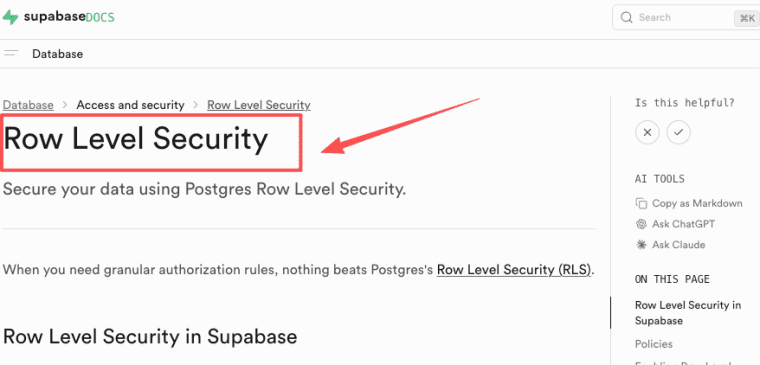
A platform built for production has to handle this from day one. That means proper user isolation in the database — specifically, row-level security (RLS), which is a PostgreSQL-level mechanism that filters rows per user before they reach your application code, not after. The difference matters architecturally: application-layer filtering depends on every code path remembering to add a WHERE user_id = current_user clause. Database-layer RLS enforces the same constraint automatically, even if application code has a bug. A minimal RLS policy looks like this:
sql
plaintext-- Enable RLS on the table
ALTER TABLE entries ENABLE ROW LEVEL SECURITY;

-- Policy: users can only read their own rows
CREATE POLICY user_isolation ON entries
  FOR SELECT USING (user_id = auth.uid());
Without this, anyone holding your database's public API key can query the entire table directly — bypassing your frontend entirely. In May 2025, security researcher Matt Palmer scanned 1,645 apps from Lovable's public showcase and found 170 of them (10.3%) had critical RLS failures, exposing personal data, financial records, and API keys. The vulnerability was assigned CVE-2025-48757 with a CVSS score of 8.26. Wiz Research independently confirmed the same class of misconfiguration in September 2025, identifying it as one of four systematic patterns in AI-generated apps. This isn't a Lovable-specific problem — it applies to any AI builder that generates a Supabase backend without enforcing RLS by default. The same checklist also includes password reset flows that actually send emails, session handling that doesn't throw users out at 3am, and infrastructure that holds when ten users are on simultaneously.
This is the layer where AI builders have historically been weakest. Not because the AI can't generate the code, but because the platform underneath might not enforce the right guarantees. If the tool generates "an auth system" without making clear what's actually production-grade vs. demo-grade, you're on your own to figure that out — usually after a user complains.
Payments, SEO, and custom domains
If you want to charge money, three things have to work together: payments, discoverability, and brand.
Payments aren't just "connect Stripe." You need a checkout flow that handles failures gracefully, webhooks that update your database when things change, and the ability to issue refunds without your app falling apart. Stripe's webhook documentation lists the events a production subscription app needs to handle: customer.subscription.deleted (user cancels), invoice.payment_failed (card declined), invoice.paid (renewal succeeded), customer.subscription.updated (plan change). If your platform only wires up the happy path — checkout succeeds, user gets access — and doesn't handle the failure events, your app will silently keep billing users after they cancel, or silently deny access to users whose cards had a one-time failure. A tool that says "we support payments" may mean anything from "we open a Stripe checkout link" to "we handle all these webhook events." Big difference.
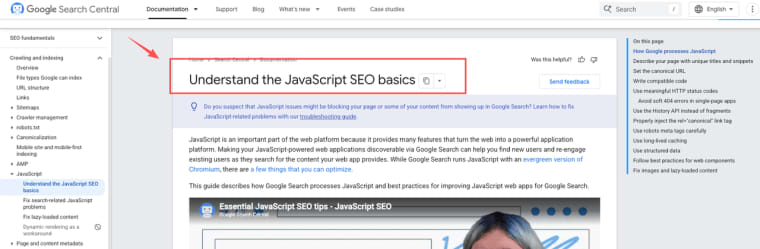
SEO is the other one people forget. AI-generated apps tend to be client-rendered (CSR) single-page React applications, which means Google's crawlers receive an empty HTML shell if JavaScript doesn't execute cleanly. Google's own documentation on JavaScript SEO acknowledges that while Googlebot can execute JavaScript, it "may not always be able to" and processes it significantly slower than pre-rendered HTML. Server-side rendering (SSR) or static site generation (SSG) solves this — but most AI builders generate CSR apps by default. Lovable's newer apps use TanStack Start with SSR by default; Bolt added native SEO features in Bolt Cloud (August 2025). Create.xyz/Anything's SSR support is not documented in their public features page. Meta tags, sitemaps, and crawlable HTML are not flashy, but they're the difference between organic traffic and being invisible.
And custom domains. You'd think this is solved, and yet — half the AI builders I've tested still leave you on a subdomain unless you upgrade twice and wrestle with DNS.
When to Consider a Create.xyz Alternative
If your prototype is purely a demo for yourself or a pitch — Create.xyz is fine. Stay. Don't make life harder than it needs to be.
But if any of these are true, start looking:
- You're charging real money and refunds are a nightmare. Anything beyond a single subscription tier gets complicated fast.
- Your app handles user-specific data that absolutely cannot leak. Client work, financial info, anything sensitive.
- You need the app to be findable on Google. AI-generated single-page apps are often invisible to search crawlers.
- You're starting to lie to yourself about the bugs. You know the ones. "It's mostly fine." "Users probably won't try that." Those bugs.
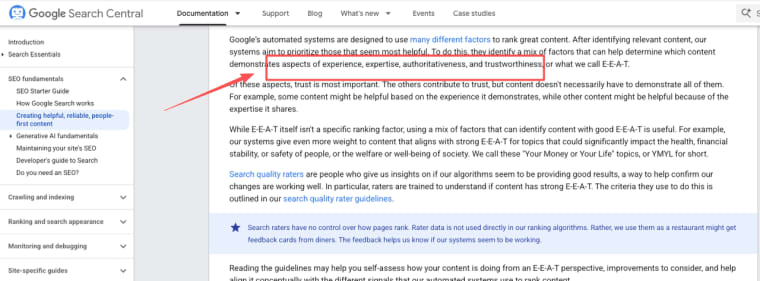
Once you're past the demo stage, the validation criteria shift. Google's own helpful content guidelines hint at this from a content angle — first-hand experience, real usage, depth of knowledge are what get rewarded. The same logic applies to products. An app that's been used by real people, with real payment data, with iteration scars on it, is qualitatively different from a generated one nobody has touched.
A useful Create.xyz alternative isn't always a fancier prompt-to-app tool. Sometimes it's a no-code platform with stricter structure but better reliability. Sometimes — this one hurts — it's hiring one freelance dev to wrap a proper backend around your prototype.
There isn't one winner. There's a thing you need next, and the platform you started with might not be it.
Anyway, I'm still somewhere in the middle of all this — testing platforms, breaking workflows, rebuilding things I thought were already done. I'll keep updating here as I figure out which tools are genuinely usable once a project stops being "just a prototype."
FAQ
What is Create.xyz behind the scenes — who runs it and is it funded?
Create.xyz officially rebranded to Anything in August 2025. It was founded by Dhruv Amin, Marcus Lowe, and Mark Craemer. Total funding sits around $19.5M, including an $11M Series A at a $100M valuation in September 2025, led by Footwork with M13, Bessemer, and Uncork participating. While it’s backed by a solid runway and not just a side project, users have reported occasional access issues during the rebrand. Platform stability should still be monitored if you plan to build a revenue-generating app.
How do builders typically use Create.xyz for AI-generated apps in practice?
It excels at building internal tools, AI utilities (text processors, image generators, niche dashboards), quick prototypes, and personal projects. It’s great in the early "vibe" stage where you want something working fast. However, it’s generally not ideal for high-traffic consumer apps or projects requiring strong data isolation and complex logic.
What should founders check when moving from AI-generated pages to live apps?
- Can you export the full source code to avoid vendor lock-in? - Are there recent complaints about losing project access or edit rights? - How predictable are credit costs over 60–90 days of active use? - Does it support custom domains, production-grade payments, and reliable error handling?
When should builders look for a Create.xyz alternative?
Consider switching when: - You need proper subscription billing, refunds, and payment lifecycle management; - Your app handles sensitive user data that requires strict isolation and compliance; - You depend on organic Google traffic (needs strong SEO and server-side rendering); - Advanced features you need are only possible through workarounds; - You catch yourself saying "the bugs are probably fine."
What makes a platform suitable for commercial AI app validation?
For me the real test is the boring stuff: clean user-facing error messages when things fail, whether refunds are a documented flow or a "contact support" trap, and whether the platform has a public changelog you can audit. Pretty UIs are easy. Operational reliability is what separates a launchable app from a screenshot.