
Twenty variants are not a testing plan. They are a folder.
An AI editor can swap the hook, presenter, music, captions, and CTA before lunch. One version wins, yet nobody can explain which change mattered. Learning how to optimize video ad campaigns with AI editors starts with resisting that temptation. The tool creates variations; the experiment creates evidence.
Start with a Clean Campaign and Creative Baseline
The unglamorous setup matters. Record the audience, placements, bid strategy, offer, destination, attribution setting, test period, and baseline creative ID. Date any landing-page or price change.
Pick one business outcome as well. An awareness video may be judged on qualified viewing and clicks; a retargeting ad may need a lead or purchase. Google Ads Experiments separates a base campaign from a trial over a defined period, a useful principle beyond Google.
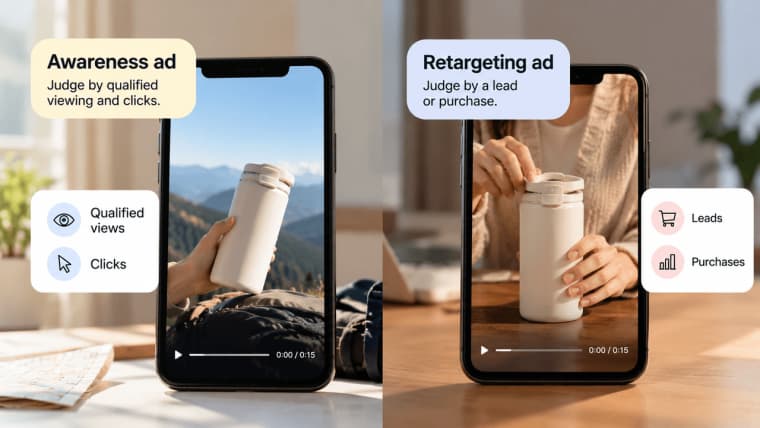
The baseline can be mediocre. It just cannot keep moving.
Build a Traceable Creative-Variant Matrix
Give every export a variant ID and record its hypothesis, changed variable, constants, source, editor or model, review status, campaign, dates, spend, and result.
| ID | Hypothesis | Only change | Keep fixed | Decision signal |
| H01 | A direct question earns more qualified attention | Opening line and first shot | Offer, body, CTA, duration | View quality plus landing visits |
| P01 | A tighter middle reduces drop-off | Cut timing | Hook, sequence, voice, CTA | Completion plus click-through |
| C01 | A specific CTA improves intent | Final line and end card | Every earlier scene | Landing visits plus conversion action |
That small table is the backbone of an AI video marketing strategy. Without it, a folder full of AI generated video ads is merely inventory.
Hook and Opening Scene
Change the first line or the first visual. Not both.
Consider a simple failure: Version A opens with a presenter asking a question. Version B opens with a product close-up, faster music, and a discount. If B wins, the hook, format, pace, and offer all want the credit. A cleaner test keeps the shot and swaps only the spoken line. Curiosity, pain recognition, offer clarity, and demonstration are testable ideas. "Make it engaging" is not.
Pacing, Cuts, and Product Sequence
For pacing, shorten pauses, move the demonstration earlier, or remove a shot while preserving the hook, claims, voice, and CTA. Do not compress the cut until the product becomes harder to understand. Faster is not automatically clearer.
Presenter, Voice, Captions, and Call to Action
A new presenter changes identity and delivery. A new voice changes emphasis. Captions affect silent viewing. The CTA changes the requested action. Treat them as separate test families, even when combining them would make the ad prettier.
Localization needs its own review. Pronunciation, timing, claims, and caption breaks can change across markets.
Use AI Editors to Change One Variable at a Time
The most useful editing prompt is boring on purpose:
Keep the 15-second duration, product shots, offer, voice, captions, music, colors, and final CTA unchanged. Replace only the first two seconds with a close-up of the lid opening and the line, "Still finding coffee in your bag?" Do not add new product claims.
Save the output as Mug_H02, not final-new-v3, and keep the instruction beside it. An AI video marketing automator may speed up rendering, but it should not rewrite the test or overwrite the approved master.
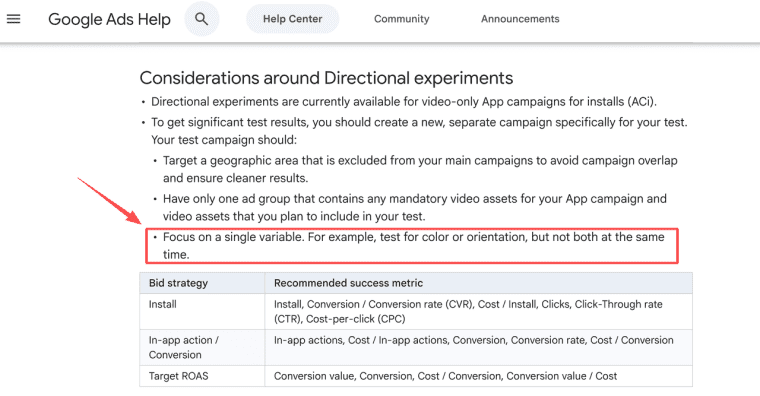
Google's directional experiment guidance recommends testing one attribute per test group. Twelve available variations still do not belong in one experiment.
Review Every Variant Before Upload
Product Accuracy, Claims, Audio, and Visual Artifacts
Watch once without sound. That is where warped packaging, changing labels, strange hands, mistimed captions, and rough transitions become obvious. Then listen without watching for pronunciation, unsupported claims, and audio cuts. Finally, pause at generated transitions and close-ups.
This pass catches an especially irritating failure: the edit keeps the rhythm of the approved scene but quietly changes the product. Prices, dates, colors, packaging, UI screens, and disclaimers all need to survive the revision.
Map Each Variant to Its Campaign and Audience
Do not let the file name disappear when uploading. Carry the creative ID into the ad account and record its campaign, audience, placement, date, and destination. If H01 reaches warm visitors while H02 reaches new prospects, creativity is no longer the only variable.
Google's video experiment setup holds the audience constant while separating video creativity. That is the standard to borrow: reduce delivery differences before crediting the edit.
Read Creative Metrics with Landing or Conversion Signals
This is where teams often talk themselves into the wrong story. A stronger opening can lift early views while doing nothing for the business. Read the sequence: impressions, early viewing, completion, clicks, landing visits, page actions, and conversions.
High views with weak clicks may mean the offer is unclear. Healthy clicks followed by poor conversion can point to the page, price, form, or tracking. Low delivery may reflect bidding, policy, or audience rather than creative quality. AI ad creative testing connects a visible edit to a plausible effect; it does not turn correlation into proof.
In one mid-size kitchen-gadget account (anonymous), the team ran H01 against the baseline. The question-hook version clearly improved early viewing and landing-page visits, yet the conversion rate stayed flat. The lift stopped at the page—form friction and a price display issue were the real blockers. Without the matrix and the full funnel read, the team would have declared the hook a "winner" and scaled the wrong lesson.
Separate Creative Fatigue from Offer, Audience, and Page Friction
A tired ad and a broken page can produce a similarly disappointing chart. Check frequency, audience size, delivery mix, offer changes, page errors, stock, and creative age. Rising exposure plus weaker viewing and clicks makes fatigue plausible. Stable clicks followed by fewer purchases after a page change points somewhere else.
Iterate the Winning Concept Without Copying It Blindly
A winner is a clue, not a template for ten nearly identical cousins. Preserve the likely mechanism but vary its expression. If a quick demonstration worked, try another clear demonstration rather than recoloring the same execution. Keep the old winner in control; Otherwise, repetition never gets tested.
A separate retargeting test on the same account later confirmed the pattern: when the team kept the winning demonstration mechanism but only changed the final CTA line (C01), landing visits improved further, and the conversion action finally moved. The earlier "hook win" had been incomplete; the matrix made the second, more valuable signal visible.
Check Rights and Disclosures When Replacing Creative
A replacement can introduce a new face, voice, track, claim, or apparent endorsement. Recheck permissions even when the change feels minor. The FTC's current endorsement guidance covers truthful representations and material connections, while platforms may add their own labels.
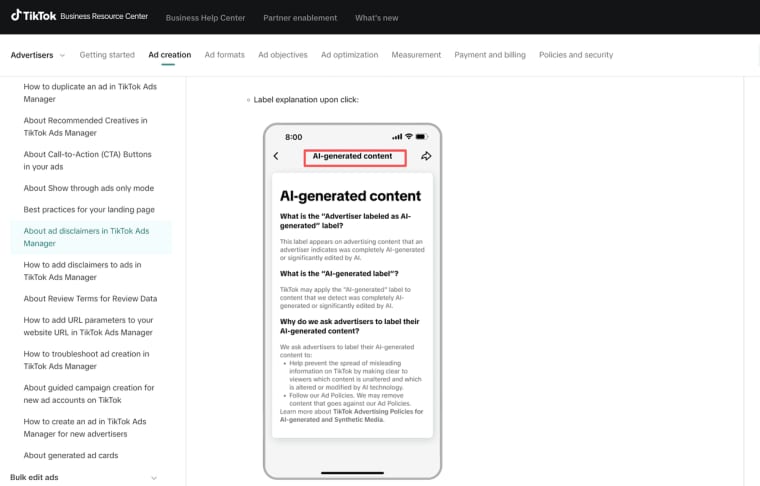
TikTok Ads requires an AI-generated content disclaimer for qualifying synthetic or manipulated media. Rules vary by platform and location. This is not legal advice.
How HappySeeds Can Support a Lightweight Experiment Tracker
Think of HappySeeds as the editing bench in this setup, not the scoreboard. With HappySeeds AI Video, a team can start from a product image, written direction, or reference video, then refine the script, scenes, voiceover, captions, music, colors, or aspect ratio through conversation.
For H03, keep the reference and product assets but change only the hook. For P02, tighten the middle without touching the offer. Save those IDs with the conversation so "make me another version" does not become the entire production record.
The advertising platform remains the scoreboard. Keep results there or in the matrix, then return to the video workflow with one defined edit.
Optimize the Creative System, Not One Isolated Metric
The team that generates the most videos does not necessarily learn the fastest. Keep the baseline still, give every variant a name, and connect the edit to an outcome that matters. "Generate ten more" feels productive. One controlled change is usually more useful.
Explore More Topics:
FAQ
Can replacing a video reset an ad platform's learning phase?
Possibly. It depends on the platform, campaign type, and replacement method. Preserve the control and record exactly when the edit went live.
Can two agencies edit the same asset without overwriting approvals?
Yes, with a client-owned master, named roles, locked exports, and unique IDs. Each agency needs an assigned copy, not the same file named "final."
Should a winning ad be retested after changing AI editors or models?
Yes. A different editor or model may alter timing, product details, voice, captions, or compression despite receiving the same instruction. Run the approved export as the control and reuse the original acceptance checks.
Can an AI editor preserve approved accessibility captions in a new cut?
Do not assume so. Keep the approved caption file, retime it against the new cut, and check accuracy, contrast, placement, and synchronization.
What if the ad platform automatically crops or enhances a tested variant?
Treat the platform-modified asset as a new variant. Record the crop, music, text, or format change and inspect the delivered version before comparing it. Otherwise, the platform added an unnamed variable.


