
Here's Elin. I've built a handful of small things on Vercel and Supabase, broken two of them in production, and spent more late nights than I'd like reading their docs to figure out why. So when someone asks me whether the Vercel and Supabase combo is "the easy way" to launch an AI app, my honest answer is: easier than wiring servers yourself, harder than the tutorials make it look. The gap between "it deploys" and "it's a real product people pay for" is where most non-technical founders get surprised.
This isn't a setup tutorial. If you've heard these two names thrown around and you're trying to decide whether this is your path, this is the version I wish someone had given me — what each tool actually covers, and what's still sitting on your plate after.
The 30-second answer
Vercel handles the front end and shipping it live. Supabase handles the back end — the database, the login system, the file storage. Together they cover maybe 60% of an AI app launch. The other 40% (roles, payments, SEO, analytics, support) is still yours to plan. The stack is great. It's just not the whole product.
Why Vercel and Supabase Show Up in AI App Stacks
These two get recommended together so often it almost feels like a default. There's a real reason. They split the app cleanly down the middle — Vercel owns what your users see and where it lives, Supabase owns where your data and accounts sit — and they're both built to connect to code you keep on GitHub.

That GitHub link is the part that genuinely changed how I work. Once your repo is connected, every push triggers a build. Vercel's GitHub integration docs lay out the default behavior: it deploys every push, gives each pull request its own preview URL, and updates production when you merge. So a vercel deploy stops being a thing you "do" and becomes a thing that just happens when you save your work. For a solo builder, that's the difference between shipping weekly and shipping never.
The appeal for AI apps specifically: these things tend to have a chatty front end (the interface where someone talks to your model) and a back end that stores conversations, users, and uploads. Vercel + Supabase maps onto that shape without you renting and babysitting a server.
What Each Tool Usually Handles
Here's the honest division of labor. I'm keeping this at the "what does it own" level because the moment you go deeper, the docs are more accurate than anything I'd summarize.
Frontend deployment, database, auth, and storage
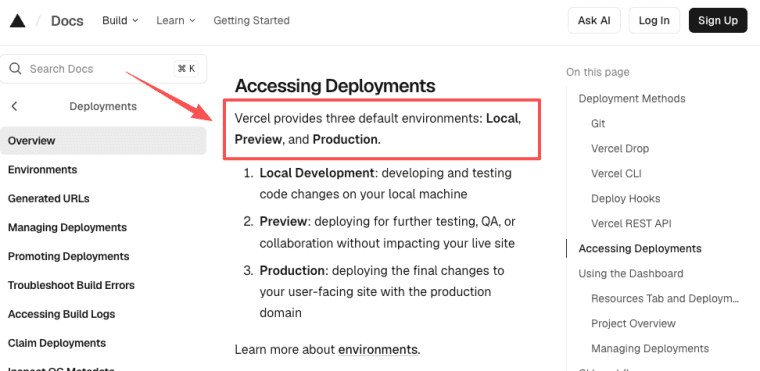
Vercel is your front end's home. It builds your app, hosts it, and manages the environments — local, preview, and production — described in Vercel's deployment docs. If your app is a Next.js or React thing (most AI app front ends are), this is the smooth part.
Supabase is the back end, built on Postgres. Per the Supabase docs, it bundles three things you'd otherwise stitch together yourself:
- Database — your AI app database lives here. Every chat, user record, and saved output sits in Postgres.
- Auth — this is where Supabase Auth comes in. Email/password, magic links, OAuth logins (Google, GitHub, etc.) — the whole "let users sign in" problem, handled.
- Storage — files. User uploads, generated images, documents your AI app processes.
Quick reality check, though: knowing the four boxes exist (deploy, database, auth, storage) is not the same as knowing how they fit your specific product. That's the next part, and it's the part the recommendation threads skip.
What Non-Technical Founders Still Need to Plan
This is the section I'd staple to every "just use Vercel and Supabase" tweet. The stack gives you capabilities. It does not give you a product. Here's what's still yours.
User roles, payments, SEO, analytics, and support

User roles. Supabase Auth signs people in, but it doesn't decide who can see what. That's a separate layer called Row Level Security — rules that live in the database itself. Supabase's own Row Level Security guide is blunt about why it matters: without it, anyone with your public key can read or modify your data. I learned that the uncomfortable way on a side project. If your AI app has any concept of "my data vs. your data" — and almost all of them do — you have to design this. It's not automatic.
Payments. Neither tool charges your customers for you. You'll bolt on a payment processor (Stripe is the usual pick) and connect it. Plan for it early — retrofitting billing onto an app that wasn't built with the idea of paid vs. free users is genuinely annoying. I've done it. Wouldn't recommend.
SEO. If you want people to find your app, the front end needs to be discoverable. Vercel hosts it fine, but the actual SEO work — titles, descriptions, content that answers real questions — is on you. Google's own helpful content guidance is worth reading once before you launch; it's the clearest statement of what search actually rewards now, and it's not what most AI-tool landing pages do.

Analytics and support. You'll want to know who's using the thing and give them a way to reach you when it breaks. Both are separate decisions. Both are easy to forget until launch week, when suddenly you have users and no idea what they're doing.
None of this is a knock on the stack. It's just the math of an AI app launch: deployment and a database are the foundation, not the building.
When a Full AI App Builder Is Simpler
Here's where I'll say something a bit against the grain. The Vercel + Supabase path assumes you're comfortable living in code, connecting services, and reading docs when something misbehaves. If that's you — or you have someone technical close by — it's a great, flexible, well-documented foundation.
But if you found this article because you've heard of these tools and the words "Row Level Security policy" just made your stomach drop a little? Be honest with yourself about that. Wiring auth, a database, storage, roles, payments, and a deploy pipeline together is real work, and every connection is a thing that can break at 11pm. There are all-in-one app builders that fold these pieces into one flow. They trade some control for a lot less plumbing.
My actual rule: if your goal is to validate an idea fast, fewer moving parts wins. If your goal is long-term control and you're okay being technical, Vercel and Supabase is a foundation you won't outgrow quickly. Different jobs.
If you take one thing from this: Vercel and Supabase is a strong, honest foundation for an AI app — I'd happily start a project on it again. Just go in knowing it's the foundation, not the finished house. Map out the roles, payments, and SEO work before you fall in love with how fast that first deploy feels. The first deploy is the easy part. It always is.
Everything here was checked against the official Vercel and Supabase docs as of June 2026. Plans and limits change — verify the current details on their official pages before you build on them.
Explore More Topics:
FAQ
What parts of an AI app take the most planning with Vercel and Supabase?
Row Level Security is the one people get wrong most often on the first build — not because it's hard to understand, but because it's easy to skip. The consequence is that when you do add it later, you often have to rethink your table structure and rewrite the queries that assumed open access. Payments is the second one: if you design your user table without a "plan" or "subscription status" column from day one, adding paid tiers afterward means a schema change plus a data migration, both of which are risky on a live app with real users.
What maintenance should non-technical founders expect with this stack?
The one that catches people off guard: free Supabase projects pause automatically after 7 days with no database activity. The trigger is actual database queries — not dashboard visits, not API calls that return cached data. A static homepage that doesn't fetch from the database won't reset the timer. When a paused project resumes, it takes about 30 seconds to wake up. For a side project that's fine. For anything a customer or investor might open unannounced, that blank screen is a problem. Beyond pausing: dependency updates, monitoring, and backups (the free plan has no automatic backups — something to know before you rely on it for anything important). Always check the official docs for current limits since these change.
When can Vercel and Supabase become too much to manage?
The clearest signal I've seen: you start debugging the infrastructure instead of improving the product. When a bug report comes in and your first question is "is this the database, the auth layer, the serverless function, or the frontend?" — and you don't have a fast way to find out — you've hit the overhead ceiling. It's not a traffic or scale problem; it's a complexity-per-hour-of-attention problem. If the stack is eating more of your week than the actual product, that's when to reconsider.
What should founders plan early if they want payments or user roles later?
Add a role column and a subscription_status column to your users table before you write a single feature. Even if both values are just "free" and "user" for the first six months, having the columns there means adding tiers later is a value change, not a schema migration. Schema migrations on live databases with real user data are the kind of thing that keeps you up at night. The five minutes it takes to add those columns on day one is worth it.
When should teams consider an app builder instead of managing the stack themselves?
When you've spent more than two or three evenings debugging the plumbing rather than shipping features. That's the practical threshold — not a philosophical one about control vs. simplicity. If the question you keep asking yourself is "why isn't this connecting" rather than "what should I build next," you're spending your attention on the wrong layer. Verify any builder's data ownership and export policies against its official documentation before committing; those terms vary and update regularly.


