Searching for Databutton in 2026 is oddly easy to get wrong. The old help center is still readable, and recent review results still describe a prompt-to-full-stack builder. Yet the official domain now lands on an industrial AI company called Riff.
I checked that public path on October 6, 2026. This is an evidence-led status review, not a logged-in product test. The useful question is no longer whether the old builder made good prototypes. It is whether an existing project still has a working login, live hosting, recoverable code, and a current support relationship.
Quick Verdict: Databutton Is No Longer the Same Product
The public evidence points to a substantial repositioning, not a routine name change. Databutton.com now redirects to Riff, whose current offer centers on AI agents for industrial operations. The public site does not currently present the former self-serve, general-purpose app builder as a product a new founder can simply register for and buy.

That does not prove every legacy project has been deleted or every old account has stopped working. It does mean that an old feature list is no longer enough for a buying decision. Existing customers should verify continuity inside their own accounts. New builders should evaluate what is sold now, not what an older Databutton review remembers.
What Happened to Databutton
The Redirect to Riff and the New Industrial Focus
Riff is aimed at industrial businesses running order handling, procurement, logistics, production planning, and aftermarket operations. Its current platform combines operational agents, shared context, interfaces, integrations, and IT controls. The examples are tied to ERP, CRM, PIM, email, supplier activity, and human escalation rather than an open-ended "describe any app" workflow.
The current Riff AI agents platform describes agents that work queues, act across business systems, and bring judgment calls back to people. That is a different buyer, sales motion, and operating model from the old Databutton app builder.
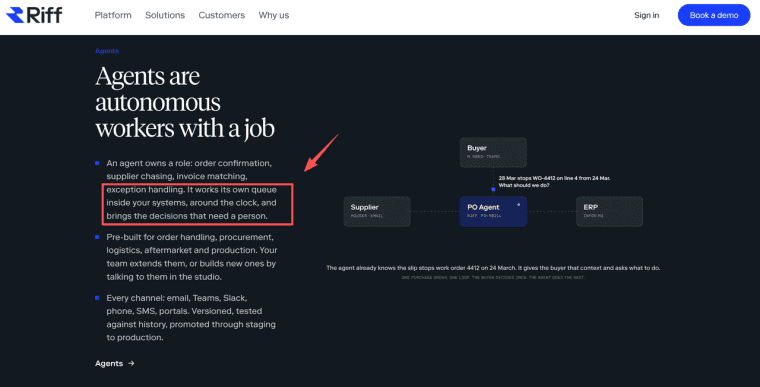
This distinction matters. "Databutton Riff" can sound like the same builder under a shorter name. Public positioning does not support that simple reading. Riff may still carry technology, accounts, people, or contracts from Databutton, but its website now sells industrial operational capacity, not a general founder tool with public self-serve pricing.
There is one more wrinkle. The Terms linked from Riff's current footer were last updated June 7, 2024. They name Databutton AS as the legal company and still describe Databutton as an AI app developer. That identifies the published legal entity, but not how legacy projects are handled today.
What the Old App Builder Promised
Historical Databutton materials describe a much broader app-building product. A user could work with generated React and TypeScript on the frontend and Python with FastAPI on the backend. The interface exposed code, authentication controls, checkpoints, deployment, custom-domain requests, integrations, and an export path.
Those details explain why old reviews sound confident. They were discussing a visible builder with a defined stack and operating workflow. They were not necessarily fabricated. They are simply dated.
Separate Historical Capabilities From Current Availability
An archived March 2025 capture of the former Databutton Help and FAQ can still show what the product documented at that time. It records ZIP code export, one-click deployment, Databutton-hosted URLs, custom-domain availability on an eligible plan, checkpoints, and restoration to a deployed version. Because this is a historical snapshot, it does not prove that any of these capabilities remain available through Riff today.
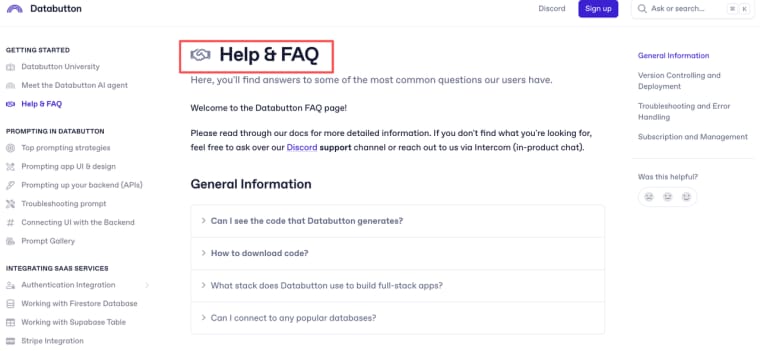
It cannot establish that these controls remain available to a new account in September 2026. It also cannot confirm current pricing, hosting commitments, support channels, export licensing, or whether the old workspace and Riff use the same account system.
A clean Databutton app builder status check should label evidence in three buckets:
| Evidence | What it can establish | What it cannot establish |
| Current Databutton redirect and Riff site | The public offer and target customer today | The fate of a particular legacy project |
| Old Databutton help center | Previously documented features and workflow | Current access, price, or support obligation |
| Third-party reviews and tutorials | What reviewers saw at their stated test date | Official continuity, endorsement, or present availability |
If a recent article repeats the old stack without acknowledging the redirect, it is not current enough to support a purchase.
Confirm Project Login and Hosting Continuity
Existing builders should resist the urge to start editing. First, preserve evidence.
- Record the account email, organization name, subscription invoice, project URL, custom domain, and last successful login.
- Open the legacy project from a clean browser session. Confirm whether the editor, preview, deployed app, logs, secrets, database connection, and billing area still load.
- Export code and business data separately if those controls remain available. A ZIP of source files is not a database backup.
- Inventory external services such as Firebase, Supabase, Stripe, model APIs, OAuth providers, email, storage, and DNS. Confirm who owns each account.
- Send support one precise request covering project access, hosting continuity, export rights, cancellation effects, and the route for security reports.
Riff's current contact route lists [email protected], while the linked 2024 terms still show [email protected] as the service contact. That mismatch is itself a reason to request written confirmation rather than rely on an old tutorial or an unanswered community thread. The current Riff contact route should be the starting point for a live support question.
Take screenshots of the account and deployment state, but do not put API keys, customer data, or payment credentials in them. If the deployed app still serves users, avoid changing DNS or canceling a plan until backups and a replacement path are verified. A redirect at the marketing domain does not tell you what a cancellation will do to an individual deployment.
What New App Builders Should Decide Instead
For a new project, this is no longer a conventional "is Databutton worth it?" decision. Riff may fit an industrial organization that wants governed agents working across ERP-connected operations. A founder trying to build a booking app, client portal, paid calculator, or lightweight SaaS needs a current general-purpose builder instead.
Write a small acceptance brief before comparing replacements:
- Who signs in, and which records may each role see?
- What data must remain after the user returns?
- Does the product take payment or change access after payment failure?
- Which domain, analytics, support, and deletion controls are required?
- Must a developer receive source code, deployment instructions, and service credentials later?
Then test the second change. Add a role, change a saved record, break an integration deliberately, and recover a failed payment. Recreated screens without the data model or recovery path are not a replacement.
When a Fresh HappySeeds Build May Make More Sense
HappySeeds enters the decision after the legacy project has been preserved, not before. If the Databutton export is usable and a developer can reproduce the deployment, continuing from that code may be more practical than starting again. If the old project was an experiment with unclear roles, data rules, or payment logic, rebuilding the product around a cleaner brief may be the more useful route.
Begin with what still matters: the user job, records, permissions, paid action, failure states, and acceptance criteria. You can then compare current no-code app builders against the same acceptance brief instead of choosing a replacement because its first screen resembles the old project.

HappySeeds may fit a nontechnical founder who wants to build and publish that revised Web workflow through conversation. Database-backed records, authentication, permissions, and Stripe flows still require configuration and live testing. HappySeeds does not document a direct Databutton import, so treat this as a fresh build and preserve the original code, data, domains, and service credentials separately.
Preserve the Project Before Choosing What Comes Next
Databutton's old documentation shows that there was a capable general-purpose builder here. Riff's current site shows a different destination: industrial operations supported by governed agents and forward-deployed work. Both statements can be true. Mixing them is what creates a misleading review.
If you already have a Databutton app, secure access, exports, service ownership, and written support answers before touching the deployment. If you are starting fresh, compare current builders against the workflow you need now. The old product name should not make that decision for you.
Explore More Topics:
FAQ
Is Databutton still the legal company name behind Riff?
The Terms linked from Riff's footer currently name Databutton AS, a Norwegian company, and use the riff.ai site address. However, that text was last updated in 2024 and retains the old app-developer description. Verify the legal entity on a current contract, invoice, registry record, or written response before relying on it for procurement or a dispute.
Do Riff's current terms reference projects created under Databutton?
The publicly linked terms describe user accounts, subscriptions, service changes, user data, and Databutton's development environment, but they do not provide a clear legacy-project transition schedule. Existing customers should request written confirmation tied to their project and contract.
Are archived Databutton code exports licensed for self-hosting?
The old help center documented code export, but export availability does not settle every license. Check the terms in force when the project was created, generated-code rights, package licenses, fonts, media, models, and third-party integrations before self-hosting.
Are third-party Databutton tutorials still endorsed after the rebrand?
Not by default. A tutorial can show a genuine historical workflow and still be obsolete today. Check its date, interface, plan names, destination links, and whether Riff currently links to or maintains it.
Where should a security issue in a legacy Databutton app be reported?
Use the current Riff Trust Center or support contact and identify the affected legacy project without emailing secrets or customer records. If the app depends on another provider, follow that provider's security channel as well. Keep a dated record of the report and response.