
Chemistry card game
The default build — elements as cards, properties as stats, reactions as outcomes.
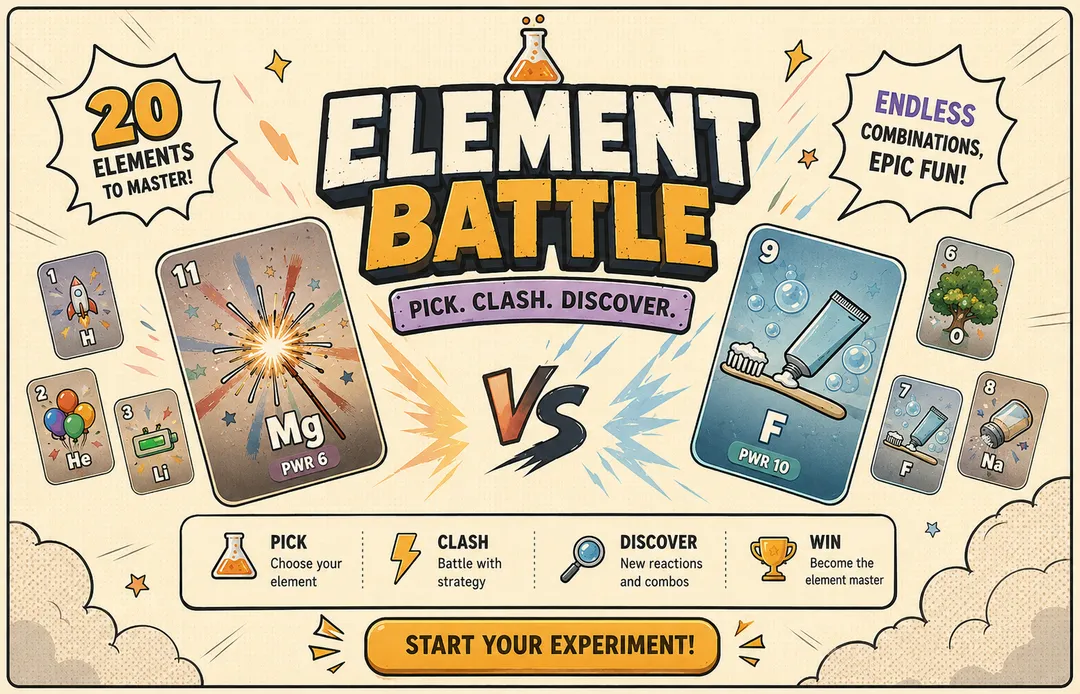
Element Battle turns chemical elements into cards. Players pick a card, compare its properties against another, and the reaction decides the round — with the reason shown. Edit the element list, the properties that matter, and the rules.
Most educational games bolt a quiz onto a game and call it learning. Element Battle fuses them: reactivity, atomic mass, electronegativity — the properties are the game, and the reaction decides who wins. A quiz asks whether fluorine is reactive; this makes you lose to it.
Remix this template Get a working copy — nothing to install or deploy.
Decide who it's for A lesson, a science club, and a casual game share mechanics but not wording.
Edit the data and the rules Change the element list, decide which properties matter, and check the explanation behind each result.
Publish and share Go live on your own domain and send players the link.
The default build — elements as cards, properties as stats, reactions as outcomes.
An activity where the periodic table is something to use, not something to memorize.
Repetition that doesn't feel like revision, because losing tells you why.
Swap chemistry for another dataset with comparable properties — the rules hold.
Real properties behind every card.
Choose which values decide a matchup.
Set how a round is played and scored.
Define what winning means, and why.
Restyle the deck without touching the rules.
Tune it for a class or for a science club.
It is a chemistry game template where chemical elements become cards and compete through their properties.
Yes. Change the element list, card copy, properties, rules, and result explanations.
Yes. It can work as a classroom activity, study tool, or casual game for science fans.
Yes. You can decide which properties matter, how each matchup is scored, and how the result is explained.
Yes. Once it is ready, publish the app to the web and share the live link.