
What Kinde Takes Off Your Plate
Kinde supplies authentication services and framework SDKs, reducing the amount of login plumbing your application must own. Your app still owns protected routes, roles, tenant boundaries, data access, account linking, and recovery behavior.
Compare this SDK-led path with the WorkOS AuthKit workflow. If identity records affect application data, pair it with the PlanetScale access guide.
Connecting Codex to Kinde
For a concrete Next.js App Router path, use Kinde's official Next.js SDK guide. The current SDK requires Node.js 20 or higher. Confirm the repository runtime before installing the package:
node --version
npm i @kinde-oss/kinde-auth-nextjs
The current guide places the auth handler at app/api/auth/[kindeAuth]/route.ts and reads KINDE_CLIENT_ID, KINDE_CLIENT_SECRET, KINDE_ISSUER_URL, KINDE_SITE_URL, KINDE_POST_LOGOUT_REDIRECT_URL, and KINDE_POST_LOGIN_REDIRECT_URL from the server environment.
Expected success: a test user can sign in through Kinde, return to the configured dashboard route, open a protected page, and sign out. A callback mismatch usually means the local URL, Kinde dashboard URL, and environment values do not match.
Minimal verification: run npm run build, start the development server, and open /api/auth/login. Confirm that the request redirects to the configured Kinde issuer. After signing in with a development test user, verify that the callback returns to KINDE_POST_LOGIN_REDIRECT_URL, the protected page can read the session, and /api/auth/logout returns to KINDE_POST_LOGOUT_REDIRECT_URL. Record the observed redirect and session result instead of assuming the flow passed.
Then:
- Select Next.js in Kinde's bring-your-own-code guide or choose the official SDK for the repository's actual framework.
- Create development credentials.
- Configure exact callback and logout URLs.
- Store the client secret in a server environment.
- Ask Codex to follow the SDK guide without replacing existing authorization logic.
Prompt: "Compare this repository with the current Kinde setup guide for its framework. Return missing files and configuration names only."
Next: "Scaffold login, callback, and logout routes. Preserve the existing user record schema and keep all secrets server-side."
For review: "Return: changed files, redirect URLs used, environment variable names, tests run, and authorization rules that still need a human decision."
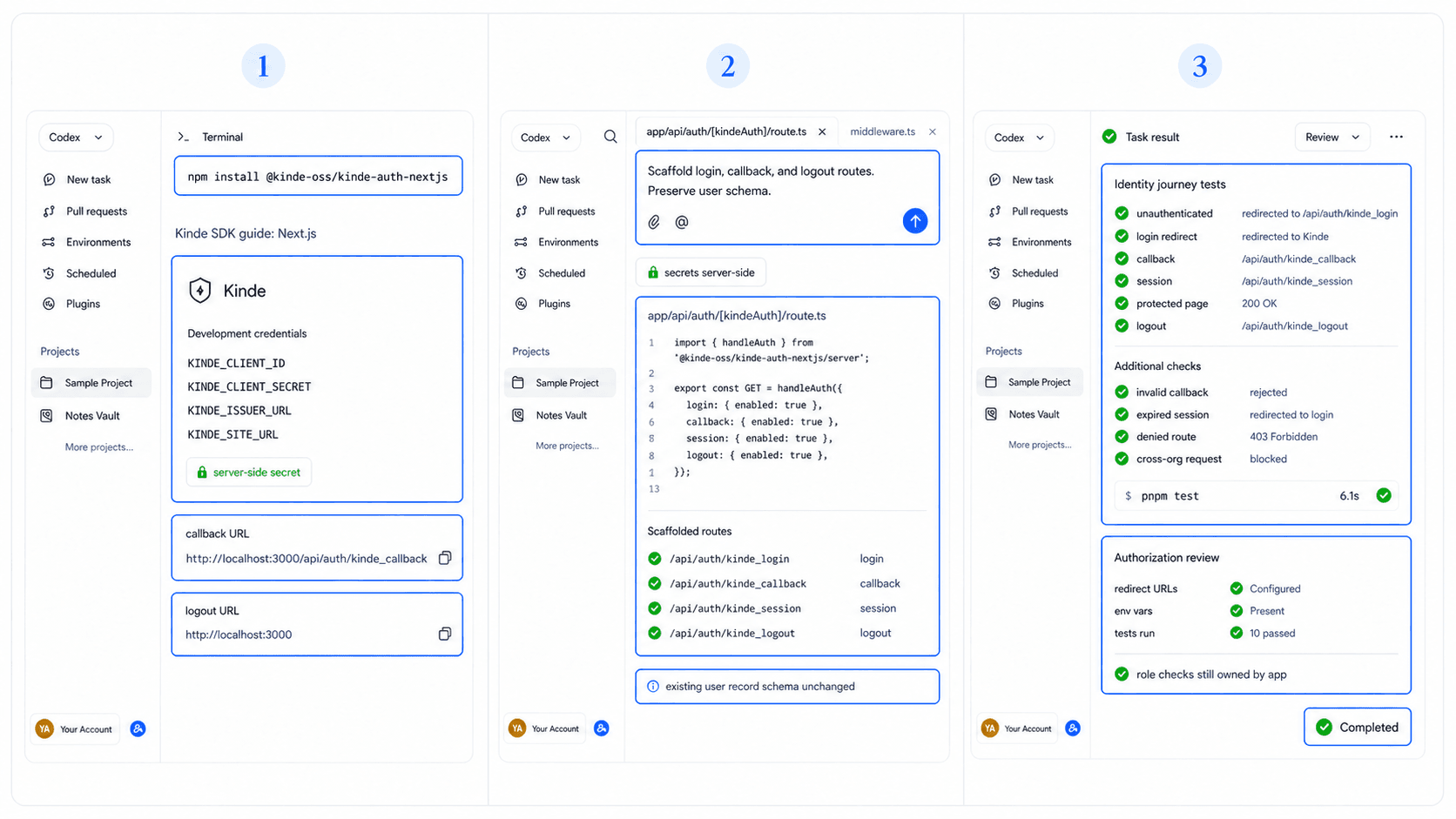
Scaffolding Login Flows Through Codex
Have Codex implement one vertical path at a time: unauthenticated visit, login redirect, callback, session, protected page, and logout. Use a development Kinde environment and a test user. Verify the browser URL after every redirect.
Do not ask the agent to invent role rules. Write an access table first, such as owner, member, and viewer, with the exact resources each may read or change.
Reviewing What Codex Generates
Check that the secret is absent from client bundles, logs, examples, and committed files. Confirm that production URLs are not copied from localhost. Test an invalid callback, expired session, denied route, cross-organization request, and logout.
Authentication success is not proof of authorization. Inspect each server-side resource check.
Map Identity States Before Adding the SDK
The technical login flow should follow the customer's onboarding path. HappySeeds helps define who signs up, what they can access, and what recovery looks like before Codex touches the SDK.
Use the HappySeeds workflow planner to map those states, then scaffold them one at a time.
FAQ
Use the official SDK for your framework and its current setup guide.
No. Keep confidential credentials in a server-side environment or secret manager.
Configure the exact login callback and logout redirect for each environment.
It can support identity and role data, but your application must enforce access to its own resources.
Map Every Identity State
Write the unauthenticated, signed-in, denied, expired, and logged-out outcomes before implementation. Browse HappySeeds app templates for a planning-first starting point.
Launch with HappySeeds
Built the app but not the business? Start with HappySeeds to launch a live, monetizable AI app, or browse AI app templates to see what you can sell.