Hi, I'm Elin. The first AI app I launched, I priced by vibes. Picked a number that felt fair, put it live, and about three weeks later noticed my ten heaviest users were each costing me more than they paid me. Every day. Classic.
So this time, before writing a word, I went and pulled up the current GPT-5.4 Mini pricing on OpenAI's official API pricing page — because the whole point here isn't the raw numbers. It's turning them into credits and a margin that doesn't bleed you the moment a power user shows up. If you're staring at the gpt 5.4 mini cost and trying to work out what to actually charge, that's what we're untangling.
Quick version for the busy: output tokens cost six times more than input, caching can knock most of your input cost off but does nothing for output, and the cheapest model isn't always the cheapest outcome. Everything below is me showing the work.
How GPT-5.4 Mini pricing affects your app economics
For tiered pricing rules (if your context pushes past certain thresholds), check the official pricing page directly — that detail moves and I'd rather send you there than quote a stale cutoff number.
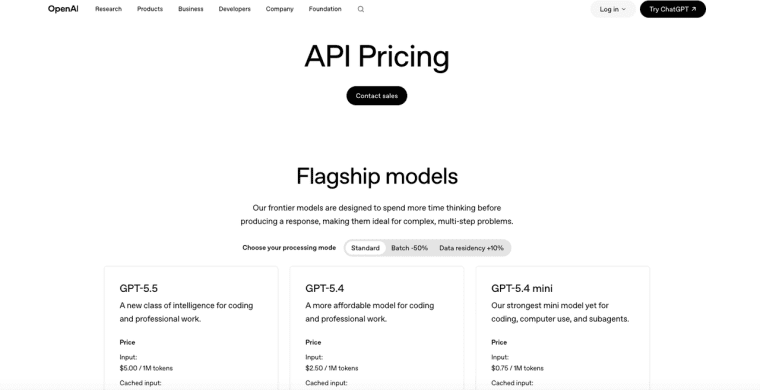
The thing most "cost per token" posts skip right over: output is 6x the price of input. Everyone obsesses over how long their prompt is. But if your app generates a lot — long answers, drafts, summaries — your cost lives on the output side, and shaving the prompt barely moves it. Another route is running Codex in Windsurf for agentic edits.
Let me make it concrete with a normal chat-style call. Say each interaction is roughly a 2,000-token system prompt plus context, a 200-token user message, and a 500-token reply.
Run a thousand of those a day and you're around $4/day, call it ~$120/month, before anything else. Those are my illustrative numbers, not yours — your context length and reply length will shift them a lot. But the shape holds: the model is cheap per call and brutal at volume, and the output line is usually the one doing the damage.
Designing credits and a free tier around real cost
Most apps don't bill users in tokens, because nobody outside our weird corner of the internet thinks in tokens. They bill in AI app credits — some friendlier unit like "1 generation" or "10 messages." Fine. But behind every credit sits a real per-action cost, and if you forget that, you're back to my first launch.
Here's the part founders underprice. An AI app doesn't have SaaS economics. AI products carry every normal cost — hosting, support — plus a compute bill that scales with usage. Your gross margin starts lower than a classic SaaS, structurally, before you've made a single mistake. So your AI app credits have to price that compute in, not pretend it's free.
The way I do it now, after getting burned:
- Define a credit as a bounded unit of work — capped output length, capped retries. An uncapped credit can cost you anything.
- Price the credit at your blended cost per action times a margin multiple, not cost plus a few cents. Multiplicative survives variance; additive doesn't.
- Leave a buffer for what you can't see yet — output that runs long, the occasional retry, a price change you didn't schedule.
For the free tier, the rule that finally clicked for me: bound it by worst-case cost per free user, not by a number that feels generous. "10 free generations" sounds nice until each one quietly costs four cents and ten thousand people sign up. Cap it, run the cheaper model there, and lean hard on caching (more on that next). Honest blind spot: I run my own stuff lean, so I haven't operated a free tier at the scale where abuse becomes a real line item. If you're there, watch it closely.
One more honest note: if you're using a platform that bundles all of this into a credit system for you, check that specific plan's terms. A lot of these don't publish their credit-to-token math, and I'm not going to pretend I can verify a ratio that isn't public.
The cost factor most founders miss: cached input
This is the one I didn't understand on my first build, and it would've changed my pricing.

When the start of your prompt repeats across requests — your system prompt, your instructions, a stable chunk of retrieved context — OpenAI can reuse it instead of reprocessing it. Per OpenAI's prompt caching guide, this kicks in automatically once a prompt prefix hits about 1,024 tokens, needs zero code changes, and cuts input cost by up to 90%. For GPT-5.4 Mini that's the $0.075 cached rate versus $0.75 — a tenth.
Let's see what cached input savings actually do — at best-case 100% cache hit rate on the system prompt:
- Cached input (2,000 tokens): about $0.0002
- Fresh input (200 tokens): about $0.0002
- Output (500 tokens): still $0.0023
- Total: roughly $0.0026 — about a third cheaper than uncached.
That's the ceiling. Real-world cache hit rates are lower, because the cache window is short — minutes of inactivity, not hours. Here's what blended input cost looks like at different hit rates:
| Cache hit rate | vs no caching |
| 0% (no caching) | baseline |
| 25% hit | −17% |
| 50% hit | −45% |
| 75% hit | −73% |
| 90% hit | −85% |
Based on $0.75 standard / $0.075 cached input rates. Output cost is unchanged at $4.50/M regardless of cache.
The message: don't model your margins assuming a 100% cache hit rate, but even 50% makes a real difference. Two rules I'd actually stake a decision on: put your stable content first (cache hits are prefix matches), and caching is almost a rounding error for chatty apps that write long responses back — output stays the dominant cost regardless.
When a cheaper model actually hurts your business
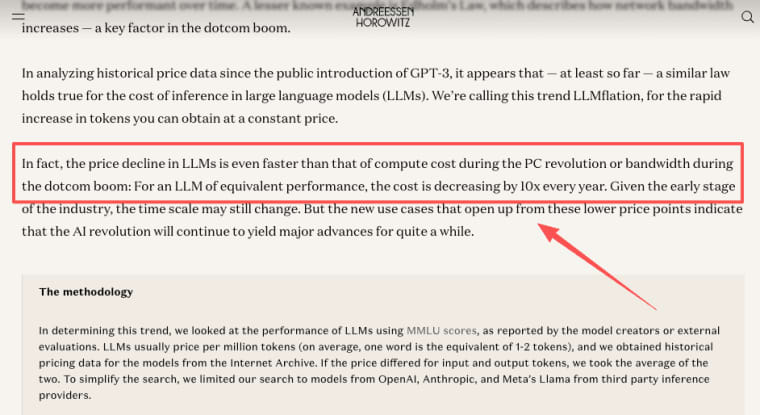
There's a gravitational pull toward always grabbing the cheapest model. It's real and it makes sense — a16z calls it LLMflation: for equivalent performance, inference prices have been dropping roughly 10x a year. Cheaper, cheaper, cheaper. Why wouldn't you?
Because cheapest-per-token is not cheapest-per-successful-outcome, and the bill comes due in places that don't show up in the pricing table.
If the mini model can't reliably do the job, three things happen, all of which cost money. Users retry — that's more tokens you pay for. You escalate the hard cases to a bigger sibling model anyway — now you've paid twice for one task. Or they churn, which is the most expensive outcome of all and never appears in your inference logs.
I did this exact thing. Downgraded one step in a flow to save money, felt clever for a week, then spent the savings — and then some — answering "why is it giving me garbage" emails. Net loss, plus my evening.
So the test I use now isn't cost per call. It's success rate. A model that's half the price but fails 15% more often is not cheaper. GPT-5.4 Mini is genuinely strong for chat, classification, and a lot of agent work — but it's the mini tier, and reasoning-heavy or precision-critical tasks may just need the bigger model. Pay for the floor your product can't drop below, optimize everything above it.
A simple cost-estimation framework for founders
If you've never sat down and done it, here's how to price an AI app at the unit level without a spreadsheet meltdown. Six steps, in order:
- Measure tokens per action from real API usage — input, cached, and output, broken out. Don't estimate. The API returns the actual counts; your gut is wrong (mine was).
- Apply the three rates — check OpenAI's official pricing page for today's input, cached input, and output prices. Don't use numbers from a blog post, including this one.
- Add a variance buffer, something like 1.3–1.5x, for retries and replies that run long.
- Discount your input by a realistic cache-hit rate, not the best case.
- Set credits or price for your target margin — and leave headroom, because prices move unpredictably. Epoch AI's tracking of inference prices shows the decline ranges anywhere from 9x to 900x per year depending on the task, which is another way of saying: don't bet your margin on a future price cut that may not arrive on your schedule.

6. Re-measure after launch. The first week of real users tells you more than any model. Mine always do.
That's it. Not elegant — but honest, and honest beats elegant when there's money on the line.
One honest note: the cost structure described here — output costing significantly more than input, caching cutting repeated input cost by up to 90% — reflects how GPT-5.4 Mini pricing works as of June 2026. The specific rates change. Before you wire any number into your billing, open OpenAI's official pricing page and confirm the current rate yourself.
Explore More Topics:
FAQ
How does GPT-5.4 Mini pricing actually impact my app’s margins?
Output tokens cost 6x more than input, so long replies drive most of your bill. Even with caching, high-volume usage can eat margins fast if you don’t price credits with a proper buffer. Always calculate real per-action cost including retries.
What is prompt caching and how much does it really save?
It reuses repeated system prompts and context, cutting input costs by up to 90%. Great for consistent instructions, but output still dominates. Place stable content first and don’t assume 100% hit rate.
How do I build a free tier without losing money?
Bound it by the worst-case cost of a single free user, not by a round number that sounds generous. Run the cheaper model, cache aggressively, and cap usage. That worst-case-per-user thinking is honestly the core of how to price an AI app's free entry point at all — if you can't say what one free user costs you, you can't size the tier.
Can choosing the cheapest model ever cost me more in the end?
Yes, and it's sneaky. A model that fails more often drives retries (more tokens), escalations to a pricier model (paying twice), and churn (the cost that never shows up in your logs). Judge models on success rate per outcome, not price per call.