I keep getting the same question from people building small AI products: what's the Grok 5 price going to be, and should I plan my app around it? Short version — I can't give you a Grok 5 price, because as of early June 2026, there isn't one. Grok 5 hasn't shipped. xAI has only confirmed it's in training. So this isn't a pricing teardown. It's the thing I actually find useful when a model is still mostly rumor: a way to think about the cost and product risk of betting on something that doesn't exist yet. Hi, I'm Elin.
Why App Builders Are Watching Grok 5 Price
If you're shipping anything that calls a model on every user action, token cost is your margin. I've broken this math on my own projects more than once — you launch, usage climbs, and suddenly the per-request cost you hand-waved at the start is the whole P&L. Search and indexing often use Codex + R2R.
So when a new flagship gets hyped, the question under "is it smart?" is really "what does it cost per million tokens, and can my app survive that?" People planning a Grok 5 AI app want to know whether to architect around it now or keep using what's live. Reasonable instinct. The catch is that the Grok 5 price question has no answer yet — you can't budget around a number nobody's published.
What Is Confirmed and What Is Not
Here's what I could actually verify, not what I half-remember from a thread.
Confirmed: xAI's January 28, 2026 Series E funding announcement stated that Grok 5 is currently in training — that's the only official reference to Grok 5 by name on xAI's public channels as of mid-2026. Not confirmed: a release date, final specs, official benchmarks, or any pricing at all. There's still no dedicated Grok 5 page on xAI's own site framing it as launch-ready.
On timing, I'd treat the louder predictions as educated guesses rather than evidence. Despite recurring rumors and leaked-spec screenshots, there has been no consistent public signal pointing to an imminent launch. Until xAI provides official guidance, any specific release date should be viewed cautiously.
And no, I can't write a Grok 5 review. You can't review a model you can't run. Anyone publishing a "Grok 5 review" right now is reviewing a rumor, not a product.
Grok 5 vs current Grok model availability
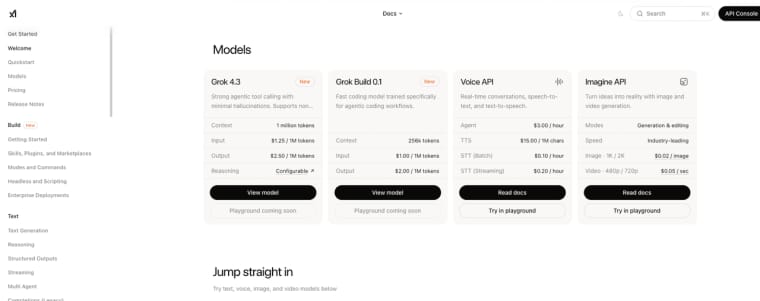
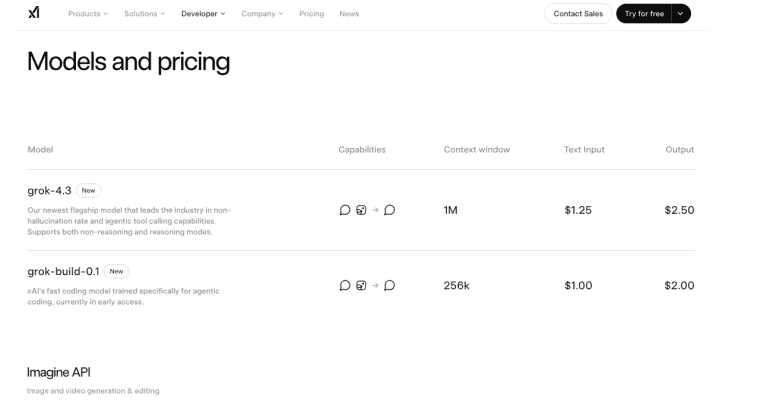
What you can actually build on today is the Grok 4 line. Grok 4.3 is xAI's current flagship, launched April 30, 2026, at $1.25/M input tokens and $2.50/M output tokens, with a 1M token context window. Those are the numbers you can actually plug into a margin model. That's the real comparison — not Grok 4 versus an imaginary successor, but Grok 4.3 against whatever else is shipping now from other providers. If your app needs to go live this quarter, Grok 4.3 is the version with numbers attached.
What's Live to Build On Right Now (June 2026)
| Model | Input (per 1M tokens) | Output (per 1M tokens) | Context window | Notes |
| Grok 4.3 | $1.25 | $2.50 | 1M tokens | Current flagship; reasoning on by default |
| Grok 4.1 Fast | $0.20 | $0.50 | 2M tokens | Lowest cost per token among frontier models |
| Claude Sonnet 4.6 | $3.00 | $15.00 | 200K tokens | Strong on coding and instruction-following |
| GPT-5.5 | ~$2.00 | ~$8.00 | 128K tokens | High benchmark scores, higher price |
| Grok 5 | — | — | — | Not released; no official pricing exists |
Prices as of May–June 2026. Always verify on each provider's official pricing page before budgeting — these numbers change.
Grok 4.1 Fast is worth flagging specifically: at $0.20/$0.50 with a 2M context window, it's a completely different cost profile from the flagship. For most RAG and chatbot workloads, the cost math looks a lot better than the headline Grok 4.3 number.
API Cost Risks for AI App Products
This is where I'd slow down. The risk isn't that Grok 5 turns out expensive. It's that you design your product economics around a price that hasn't been set, and then it shifts under you.
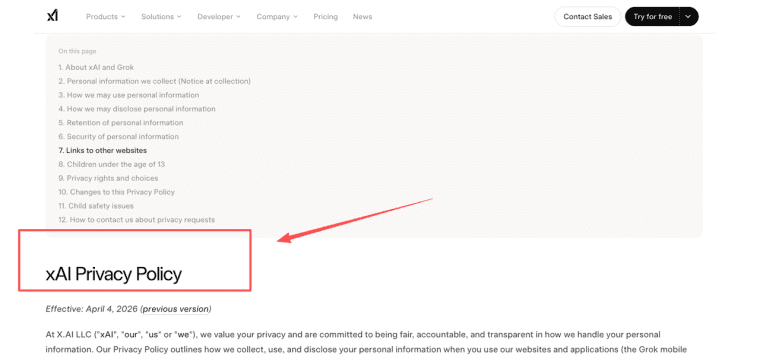
I'm not going to quote you a token rate here, because the only honest source is xAI's official API pricing page, and those numbers move. Pull it yourself the day you're costing things out. What I will flag about xAI's data-sharing program: as of mid-2026, the original $150/month credit program has ended — treat it as historical unless your current xAI Console explicitly shows it as available for your account. If a version of the program is still active when you read this, there's a second thing to know before enrolling: once a team opts in to data sharing, that decision is irreversible — you cannot opt out. Their privacy policy and data controls are worth ten minutes before you commit, especially if you're routing user content through the model.
Usage, margins, and pricing model uncertainty
A few things that have actually bitten me:
- Input and output tokens are usually priced very differently. A chatty model that writes long answers can cost far more than the input rate suggests.
- Cached-input pricing and large-context surcharges shape the real bill, not the headline rate.
- "Cheaper per token" doesn't mean cheaper per task. A model that needs more tokens to get there can cost more overall.
None of that is knowable for Grok 5 yet. So if you're modeling margins, model them on a live model, and leave Grok 5 as an upside scenario — not a dependency you've already wired in.
What Founders Should Verify Before Planning Around Grok 5
When Grok 5 does land, don't take a blog's word for it (including this one — recheck the date at the top). Verify these against primary sources:
- Release and access — generally available or closed beta? API, app, or both?
- Capabilities — real benchmarks and context limits, not promo claims.
- Price — exact input, output, and cached rates on the official pricing page.
- Commercial use — can you build a paid product on it, and under what terms?
- Rate limits — the throughput you actually get at your tier.
- Data policy — what's logged, retained, and used for training.
That last one matters most if you handle user data. xAI's Zero Data Retention option is enterprise-only: when enabled, prompts, completions, and associated metadata are processed in real time but never persisted to servers. If you're not on an enterprise plan, your API requests are retained by default — read the current API terms to understand the retention window before you route sensitive user content through the model. Note that xAI's API data policy is separate from X's social platform policy; the TechCrunch report on X opening user posts to third-party AI training is about the social network's terms, not your API contract. Read both, separately, before you assume a default setting protects you.
Bottom line: there's no real Grok 5 price to plan around yet, so build on what's live, keep your stack provider-swappable (xAI's API is OpenAI-compatible, which helps a lot here), and treat Grok 5 as a maybe rather than a roadmap.
Explore More Topics:
- Opus 4.8 Pricing for AI App Builders: Costs and Risks
- Momen Alternative: Choosing the Right AI App Builder for MVPs
- Create.xyz Alternative: Faster Ways to Launch AI-Powered Apps
- Bubble App Builder Review: Is Bubble Right for Your Startup?
- Bubble Pricing Plans: How to Understand Workload Units & Plan Tiers
FAQ
Can AI app builders use Grok 5 yet?
Not as a released product. There's no public Grok 5 API — the Grok 4 line is what's live. Grok 4.3 is the current flagship with a documented API; Grok 4.1 Fast is the budget option. For current model availability, check xAI's official documentation directly rather than secondhand summaries — model names and access tiers change faster than blog posts update.
Is Grok 4.3 good enough for most AI app use cases right now?
Yes — for the majority of chatbot, RAG, and agentic workloads. It offers strong reasoning, 1M context, and competitive pricing ($1.25/$2.50). Many developers are shipping production apps on it while waiting for Grok 5.
What's the actual risk of designing around an unreleased model?
It's not that the model turns out bad. It's that you've made architecture decisions — provider lock-in, UX promises to users, margin projections — based on a number that hasn't been set. When the number finally arrives, it might not match what your product needs. Building on a live model and keeping your stack provider-swappable (xAI's API is OpenAI-compatible) is cheap insurance against that scenario.
Does xAI still offer free credits or data-sharing incentives?
The original $150/month credit program has largely ended or changed. Check your xAI Console for any active promotions. Data-sharing options (if available) are usually irreversible — review the privacy policy carefully.