How much is Bubble? It depends first on your launch track: Web only, native Mobile only, or Web + Mobile. The Bubble price also depends on billing cadence and server workload. A Web + Mobile project shares one plan and WU allowance across its apps; separate projects need separate plans.
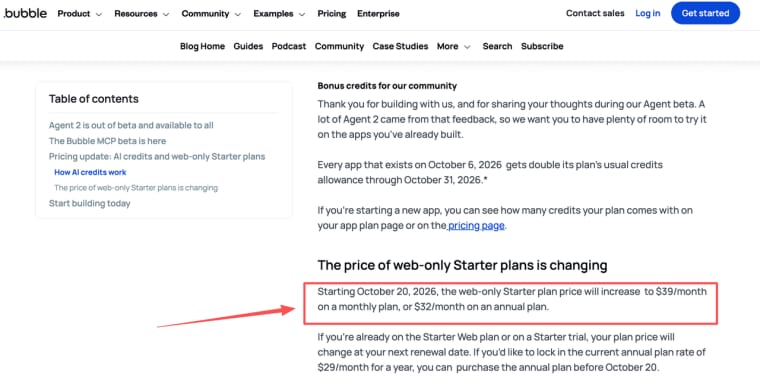
HappySeeds put this guide together. We also build AI apps ourselves. The prices below come straight from Bubble's public plans (checked October 20, 2026, in USD before tax). We didn't rebuild the same app on both platforms or dig into actual invoices for this piece. As of October 20, the Web-only Starter plan has increased to $39 monthly or $32 monthly equivalent billed annually; the table below reflects the new rates. Existing subscriptions move to the new price at renewal.
Why Bubble Pricing Feels Hard to Compare
Starter, Growth, and Team come with different features and different amounts of included Workload Units (WU). You can also add a workload tier if you just need more capacity without upgrading the whole feature set. So in practice you have to budget three things: the base plan, any tier, and possible overages.
Bubble tracks server work in WU. Every database search, workflow run, or API call eats into the monthly total. One user doing a few things can trigger a bunch of operations, which is why "number of users" alone is a terrible way to guess your bill.
Two apps with the same user count can burn very different amounts of WU depending on how heavy the searches and background jobs are. Better to list the actual operations and how often they fire than to rely on some average users-to-WU ratio. And remember: WU is about volume, not speed.
Bubble gives paid apps 100,000 WU per month for Development, and both Development and Live usage count toward the total. Their public docs are a bit vague on whether that 100k sits on top of the plan quota or how they bill Development usage past it. The examples later only count Live WU. Always check your own app’s metrics before treating any estimate as a real forecast. See the pricing FAQ.
What Bubble Pricing Plans Are
Plan structure and usage limits to verify
The first pricing boundary is deployment. Free lets you build and test in Development; a live release needs a paid plan. Read the table by the track you intend to publish, then compare the billing cadences within that track.
Prices are in U.S. dollars before tax. The annual column shows the monthly equivalent and the 12-month total in parentheses; annual plans are billed yearly.
| Plan | Product track | Monthly billing | Annual billing (monthly equivalent; 12-month total) | Included WU per month |
| Free | All tracks (development only) | $0 | Not applicable | 50,000 |
| Starter | Web only | $39/mo | $32/mo equivalent ($384/yr) | 175,000 |
| Starter | Mobile only | $49/mo | $42/mo equivalent ($504/yr) | 175,000 |
| Starter | Web + Mobile | $69/mo | $59/mo equivalent ($708/yr) | 175,000 |
| Growth | Web only | $134/mo | $119/mo equivalent ($1,428/yr) | 250,000 |
| Growth | Mobile only | $199/mo | $169/mo equivalent ($2,028/yr) | 250,000 |
| Growth | Web + Mobile | $249/mo | $209/mo equivalent ($2,508/yr) | 250,000 |
| Team | Web only | $399/mo | $349/mo equivalent ($4,188/yr) | 500,000 |
| Team | Mobile only | $529/mo | $449/mo equivalent ($5,388/yr) | 500,000 |
| Team | Web + Mobile | $649/mo | $549/mo equivalent ($6,588/yr) | 500,000 |
| Enterprise | Quote for the selected track | Custom quote | Custom quote | Custom |
As of October 20, 2026, Web-only Starter is $39 monthly or $32 monthly equivalent billed annually ($384 per year). Existing Web Starter subscriptions and trials move to the new price at their next renewal; anyone who purchased the annual plan before October 20 locked in the previous $29/mo rate for that year. This table reflects the prices in effect from October 20 onward. Always recheck Bubble's official pricing page and the Web Starter price-change announcement before subscribing. The same announcement also separates AI credits from WU and says collaborators share those credits.
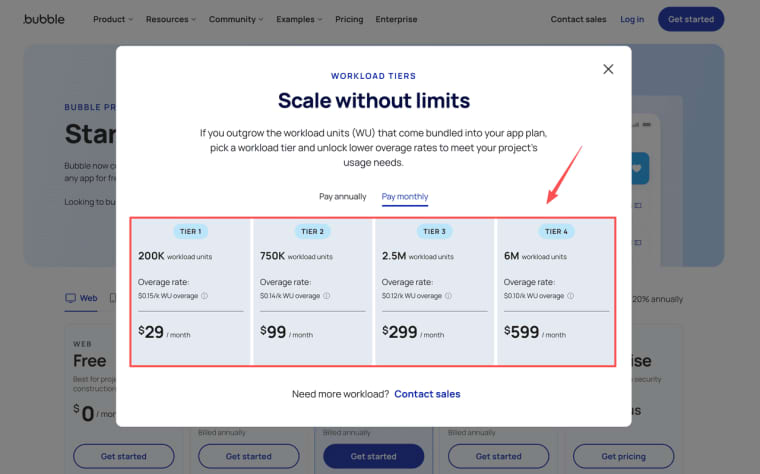
Budget WU separately. Starter, Growth, and Team can cover extra usage with pay-as-you-go overages or a tier that adds WU to the plan allowance. With a tier, its marginal rate applies only after the combined allowance is used. Without a tier, Bubble's default overage rate is $0.30 per 1,000 WU.
| Workload tier | Added WU per month | Monthly billing | Annual billing (monthly equivalent; 12-month total) | Overage rate above plan + tier WU |
| Tier 1 | 200,000 | $29/mo | $26/mo equivalent ($312/yr) | $0.15 per 1,000 WU |
| Tier 2 | 750,000 | $99/mo | $89/mo equivalent ($1,068/yr) | $0.14 per 1,000 WU |
| Tier 3 | 2,500,000 | $299/mo | $269/mo equivalent ($3,228/yr) | $0.12 per 1,000 WU |
| Tier 4 | 6,000,000 | $599/mo | $539/mo equivalent ($6,468/yr) | $0.10 per 1,000 WU |
Starter plus Tier 1 covers 375,000 WU per month (175,000 plan + 200,000 tier); over that, Tier 1's $0.15-per-1,000 rate applies. Without a tier, the default $0.30 rate starts above the plan's 175,000 WU. Free apps cannot add tiers or overages.
Plan and tier must use the same billing cadence; Bubble prorates the first tier charge to align with the plan. The subscription follows its start date, but WU and overages use calendar months. Monthly-plan overages for the previous month are charged at 12 AM UTC on the last day of that month; annual-plan overages are charged at the start of the next month. Bubble emails alerts at 75% and 100% of available WU. If overages are off and the app reaches its plan-plus-tier limit, it goes offline until the next billing period or until you enable overages or add a tier. See the billing and notification FAQ.
Your total Bubble cost can also include separate recurring charges:
| Cost item | What to check |
| Additional file storage | Listed at $3 per month per 100 GB. Check included storage and how partial blocks are rounded. |
| Plugins | May be free, one-time, or recurring; API-backed plugins may add provider fees. Check the listing and API terms. |
| External services | Bubble API activity can add WU; the provider may bill separately. Check its terms and price. |
| Native app developer accounts | Apple and Google fees are separate from Bubble. Verify their current terms directly. |
| AI credits | Agent edits and image generation use credits separately from WU. Check the App Plan page for the allowance and manual top-up price. |
Include any AI-credit top-up you expect to need in the budget.
How Founders Should Think About App Builder Cost
Prototype cost vs launch cost
For a launch estimate, separate the plan fee from the usage bill. List the searches, writes, API calls, and workflows behind the journey you will release, estimate how often they run, and compare the resulting WU with the plan allowance. Put the transaction-count assumption beside your estimate; it is easier to challenge that number now than to explain an unexpected bill later.
Quick note: the numbers below are just examples, not real bills. We're using USD, assuming overages are turned on, counting only Live WU, and ignoring tax, storage, plugins, AI credits, Development usage, and any third-party fees. The yearly scenario also assumes usage stays the same every month.
Example 1: Web + Mobile Starter, billed annually, at 400,000 Live WU each month
Without a tier, the annual plan is $59 per month equivalent ($708 for the year). Of 400,000 WU, 225,000 exceed Starter's 175,000 allowance, so monthly overage is 225,000 / 1,000 x $0.30 = $67.50. At the same usage for 12 months, the hypothetical annual total is $708 + (12 x $67.50) = $1,518.
With annual Tier 1 plan plus tier costs $59 + $26 = $85 per month equivalent ($1,020 for 12 months) and covers 375,000 WU. The remaining 25,000 costs 25,000 / 1,000 x $0.15 = $3.75 monthly, for a hypothetical total of $1,020 + (12 x $3.75) = $1,065. That is $453 less in this scenario; overages are still billed monthly on annual plans.
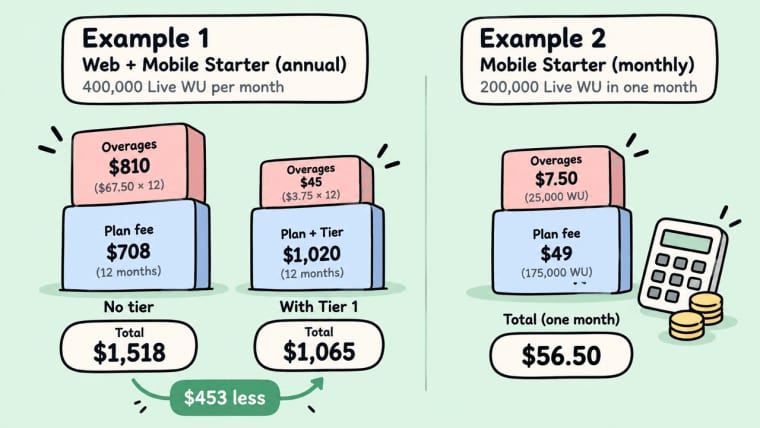
Example 2: Mobile Starter, billed monthly, at 200,000 Live WU in one month
At $49 per month, Mobile Starter includes 175,000 WU. The 25,000 excess costs 25,000 / 1,000 x $0.30 = $7.50, for a hypothetical Bubble charge of $49 + $7.50 = $56.50 before taxes and add-ons.
For a real forecast, replace the example usage with the app's own readings for an ordinary and a busier month. Bubble's App Metrics guide shows how to trace WU to searches, workflows, API requests, and expressions.
When Pricing Should Trigger an Alternatives Search
Growth and Team add collaboration and management features; a workload tier adds WU without changing the feature plan. If usage is the only reason to upgrade, compare the lower plan plus a tier with the higher plan before paying for features you do not need.
Make the alternative quote comparable to the release you intend to ship. If it is one customer-facing Web app, price one Web app on each builder, with the same project count, team access, billing term, expected workload, and necessary add-ons. Keep the brief beside each quote; a cheaper proposal is not comparable if it quietly leaves out authentication, billing, or support. If the least expensive Bubble plan-and-tier combination that covers those needs is beyond your pilot budget, or the required features force an upgrade you cannot justify, test another route before committing. Use your own ordinary and busier-month readings for that decision, not a vendor's lowest advertised price.
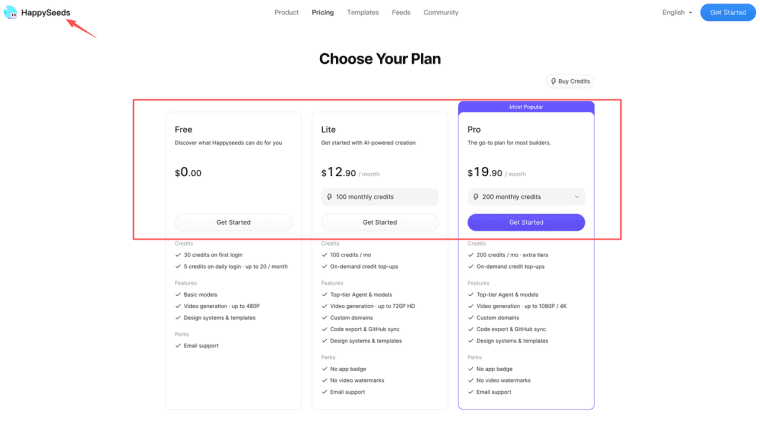
HappySeeds belongs in that comparison if your brief is for a website or Web app you want to create through chat, with database records, login, or Stripe payments to configure and test. Those are its published product capabilities; its Free, Lite, and Pro plans use Credits for app and video creation. Credits are not Bubble WU. Compare the functions your app needs and each tool's own usage rules instead of converting one allowance into the other.
Explore More Topics:
FAQ
What are Bubble pricing plans?
Bubble offers Free for development and paid Starter, Growth, Team, and Enterprise plans across Web, Mobile, and Web + Mobile tracks. Plans are priced per project, bundle track-dependent features and monthly WU, and offer monthly or annual billing. A Bubble subscription can also incur workload-tier fees or pay-as-you-go overages after its included allowance. Check the dated price table above and recheck Bubble's official page before subscribing.
Is Bubble free to start?
Yes. The Free plan lets you build and test in Development; a paid plan is required to deploy a live app. If you want to try Starter features first, eligible new apps can start a 14-day trial within 10 days of creation. The trial converts to a paid Starter subscription unless you cancel before it ends. Check the trial terms in Bubble's pricing manual before activating one.
How do I estimate my app's monthly Workload Units usage?
Pick one typical user flow and write down everything it hits on the server—searches, how many records come back, workflows, API calls, background jobs. Look at those same actions in App Metrics, multiply by how many times you expect that flow to happen in a month, then throw in the extra background work and any busy spikes. For scheduled workflows, count every single run, including retries and the ones people trigger by hand.
If my annual plan renews mid-month, when do my Workload Units reset?
Example only: if you start an annual plan on May 18, the subscription renews on May 18, but the WU counter resets on June 1. Bubble calculates overages from calendar-month usage, so the annual renewal date does not restart the monthly meter.