Elin here. I almost shipped an AI feature a few weeks ago without checking what it would cost me per user. Classic me. I'd built the whole flow, wired up the model, admired it for a bit — and only then thought: wait, what happens to my margins when 500 people actually use this thing?
So before I write a word about the MiniMax M3 price, here's what I did: I opened the pricing pages, pulled up the OpenRouter listing, read the launch coverage, and did the boring napkin math. This post is that math, from the angle most write-ups skip — not how to call the API, but how the model's cost flows into your credits, your free tier, and whether you make any money at all. Honest flag: I haven't run M3 in a high-traffic app myself. The pricing I checked against the sources; the margin math is napkin math, and I'll keep "I tested this" and "I read this" separate throughout.
The 30-second answer
If you're busy: M3 is cheap as a model, but "cheap model" and "profitable app" are two different sentences. Your real cost isn't the headline per-token rate — it's that rate multiplied by output tokens (the pricier half), retries, agent loops, and a free tier you probably set too generously. Database-backed apps often start from the Codex PlanetScale guide. Price your credits off the standard rate, not the launch promo, and leave a buffer. Everything below is the long version.
How MiniMax M3 pricing works for app builders
Here's the thing that trips people up about the MiniMax M3 price: there are two of them, and they're not the same number.
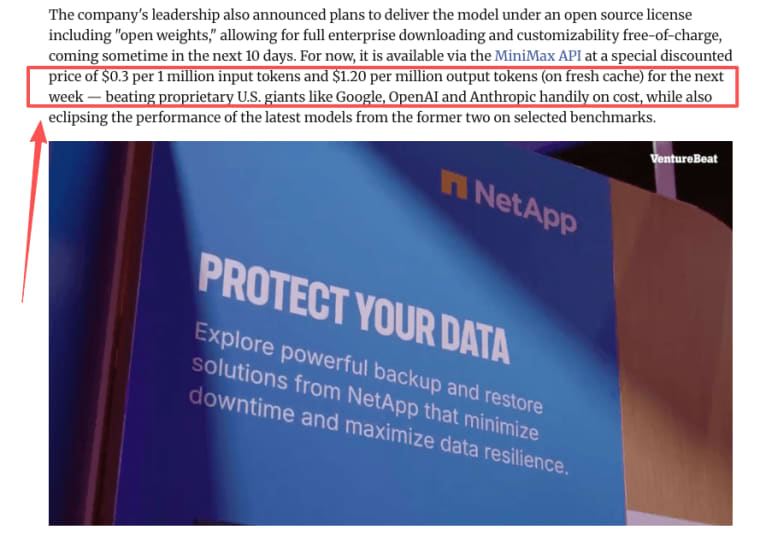
M3 went live to the API on May 31, 2026 (Eastern time), with MiniMax's official announcement dated June 1. As VentureBeat reported at launch, the half-price window was explicitly "for the next week", which originally pointed to the promotion ending around June 7–8, 2026. However, as of June 16, 2026, OpenRouter and several other platforms are still showing the discounted rate of $0.30 / $1.20 per million tokens. Promo periods can vary across providers and platforms, so the most reliable way to check is to visit the OpenRouter MiniMax M3 listing on the day you read this.
This matters more than it sounds. Build your credit economy on the standard rate, not the promo. If you anchor to the discounted number and it snaps back, your margins halve overnight.
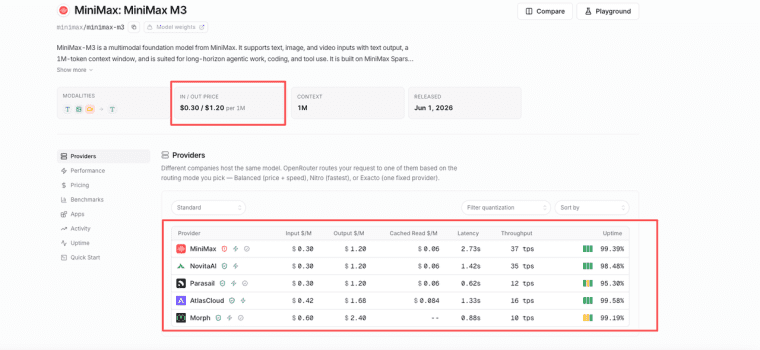
A few other things baked into the MiniMax M3 API cost that people miss: output tokens run roughly 4x the input rate, so long responses skew your bill toward the output column. And the provider you route through changes your effective cost — Artificial Analysis's provider comparison shows seven active providers for M3 as of June 2026, with blended per-million-token prices ranging from $0.22 (Parasail, Together AI, Novita) to higher on others. That's a real spread. If you're routing through OpenRouter at the standard rate and volume justifies it, checking whether a direct provider integration saves money is worth 30 minutes — the same model, different bill.
One more number worth knowing: M3's maximum output per request is 512K tokens, not the full 1M input window. For most app tasks this isn't a constraint, but if you're building agents that produce very long outputs in a single call, that ceiling exists and you should design around it. And prompt caching on repeated context drops the blended cost substantially — where you claw money back if your app reuses a big system prompt.
Turning API cost into credits and a free tier
This is the part the model-comparison blogs never touch, and it decides whether you survive. AI app monetization isn't about the API price — it's about the gap between what a request costs you and what it earns you. Treat the per-token rate as cost of goods; your credits and free tier decisions keep that math positive.
Three things I'd nail down before launch:
Credit-to-cost ratio. Know what one user action costs in real money, then price the credit to cover cost plus margin plus the requests you eat on free users. Founders price credits too thin because they anchor to the cheap input rate and forget output is the expensive half. One thing worth building into this calculation from day one: provider arbitrage. The same M3 model costs materially different amounts depending on which provider you route through — Artificial Analysis shows a 131% speed difference and a meaningful price spread across seven providers as of June 2026. Your credit pricing doesn't have to be locked to one provider's rate. Build the credit economy on the highest realistic rate you'd pay, then treat any cheaper routing you negotiate later as margin expansion rather than something your users are entitled to.
Free tier ceiling. A free tier is a marketing cost — you're paying MiniMax so strangers can try your app. Fine. An uncapped free tier is not. "Free up to X actions, then upgrade" is a sentence your bank account will thank you for.
Here's a frame I find more useful than just "cap it": calculate your free tier cost per acquired user, and compare it to your expected LTV. Take the API cost of the free actions you're giving away, divide by your trial-to-paid conversion rate, and that's what you're actually paying to acquire each paying customer through the free tier. If free users get 10 actions at $0.02 each = $0.20 in API cost, and you convert 1 in 20 free users to paid, your effective CAC from the free tier is $4.00 — before you count the 19 people who used it and left. That number might be fine. It might not be. But you should know it before you open the tap, not after.
Transparency. Don't bury what a credit costs or how fast it burns. People forgive a paid product; they don't forgive feeling tricked when credits vanish mid-task. Show the meter, and flag heavy actions before they're spent. I've churned from tools over exactly this.
Common pricing mistakes that kill margins
Most ways founders get the MiniMax M3 price wrong are about the math, not the model. I've made versions of most of these — call it scar tissue, not expert advice.
- Pricing off the promo rate. The number one killer, so it's first. Build on the standard rate; treat any discount as a bonus, not a foundation.
- Forgetting output tokens are the expensive ones. Estimate cost using only the input price and you'll underprice everything. Model both columns.
- Ignoring retries and agent loops. The sneaky one. If the model plans, calls tools, reads results, and tries again, one user action might be ten model calls. Your bill is whatever the loop consumes.
- An uncapped free tier. One enthusiastic free user running long-context requests all day can cost more than three paying customers bring in.
- Skipping system-prompt overhead. That big instruction block you prepend to every call? You pay for it every single request. Caching is your friend.
Open-weight and long-term cost: when self-hosting could matter
Okay, here's where it gets tempting — and where I want to slow you down. M3 shipped as an open-weight model, so in theory you can download it, run it on your own hardware, and the per-token bill goes away. For an app doing serious volume, that sounds like a dream. Two reasons I'd pump the brakes, especially if you're non-technical.
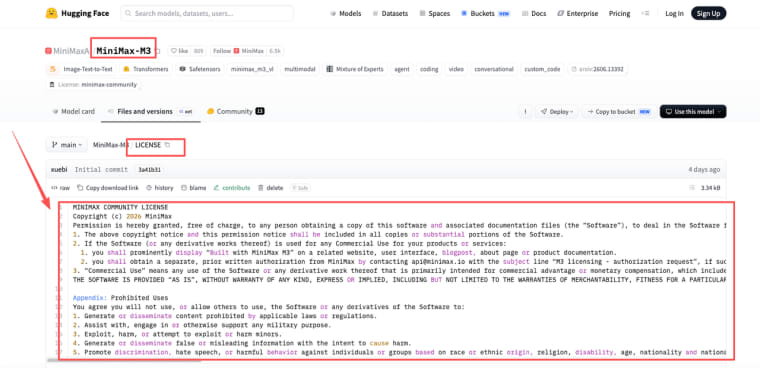
First, the license. Open weights does not automatically mean "free for commercial use." MiniMax's previous models shipped under terms that restricted commercial use without permission, and M3's license on Hugging Face carries commercial conditions people are still arguing about in the community threads. I'm linking the actual license rather than paraphrasing — my summary could be wrong, and here the details matter. Read it before you build a business on it.
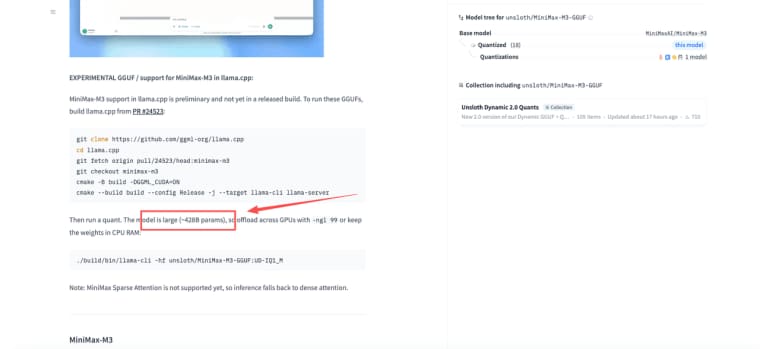
Second, the hardware reality. This isn't a model you spin up on a cheap GPU. The community GGUF builds on Hugging Face put it around 428B parameters — you're offloading across multiple GPUs or renting serious cloud compute. The per-token bill disappears, but a hardware bill plus ops work replaces it. That trade only makes sense at high, stable volume.
My honest read (a read, not a tested conclusion): if you're early, non-technical, or your traffic is unpredictable, stay on the hosted API. Self-hosting is a "demand already validated, volume huge and predictable" move — not a launch-day one.
When to use MiniMax M3 vs cheaper alternatives
So is MiniMax M3 cheap? Versus closed frontier models — yes, dramatically, at roughly 5-10% of their cost while staying frontier-adjacent on benchmarks. But "cheap versus Claude Opus" is the wrong frame for a lot of apps.
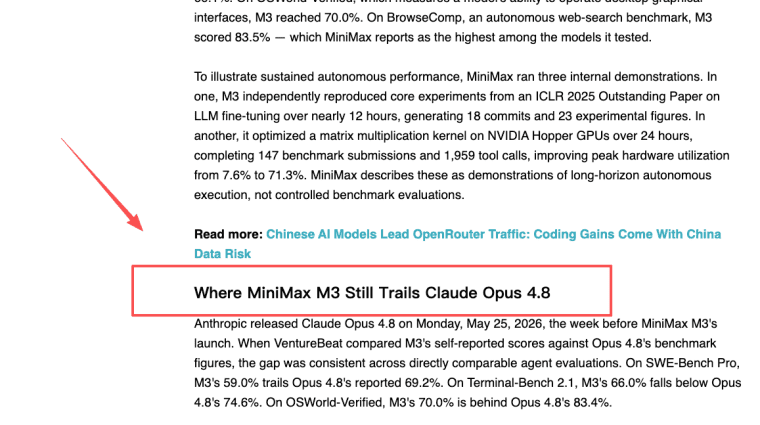
A few realities to weigh. There are cheaper models still — smaller MiniMax models and rivals like DeepSeek-V4 Pro undercut M3 on raw price, so if your app does something simple you're paying for capability you don't use. The benchmarks are also vendor-run: TechTimes flagged this clearly, noting M3's scores come from MiniMax itself and still trail Claude Opus 4.8 on directly comparable agent tests, so test it on your workload before trusting the leaderboard. Where M3 earns its price is the hard stuff — long-context work, agentic coding, reading whole repos — where the 1M window and cost efficiency genuinely pay off. Match the model to the job, not the hype.
A simple way to estimate your real monthly cost
No spreadsheet wizard needed. You just have to be honest about the multipliers.
Per request, estimate (input tokens × input price) + (output tokens × output price). Then — the part people skip — multiply by your loop factor (how many model calls one user action really triggers, retries included), then by monthly requests, then add a buffer for the free users you're subsidizing.
Quick sanity steps:
- Count the tokens in one real request, system prompt included. Not your guess — open the actual prompt.
- Use the standard rate, not the promo.
- Multiply by your loop factor. For an agent, that's probably 3-10x, not 1x.
- Project monthly volume, including free-tier usage.
- Add 20-30% on top, because you forgot something. You always forget something.
To make step 3 less of a guess, here are the loop factors I'd plug in by app type as a starting point — these are estimates based on typical agent patterns, not measured averages, so treat them as a floor rather than a ceiling:
| App type | Typical loop factor | Why |
| Single-turn Q&A or summarization | 1–1.5x | One call, maybe one retry |
| RAG (retrieval + generation) | 2–3x | Retrieval call + generation call + occasional rerank |
| Agentic coding assistant | 5–10x | Plan → tool call → read result → revise → try again |
| Multi-step workflow automation | 8–15x | Each step is a model call; error handling adds more |
If your app fits somewhere between two rows, use the higher number. The cost of being wrong is asymmetric: underestimating loop factor means underpricing credits, which is the mistake you can't fix quietly after launch.
So, what would I do?
Build your credit and free-tier math on the standard MiniMax M3 price, not the launch discount. Model both token columns, multiply by your real loop factor, cap your free tier, and be honest with users about what a credit costs. Self-hosting is a later problem; a cheaper model might be a solution today.
Then do the thing I keep failing to do on the first build: check the live pricing page one more time before you commit. Prices move. Better to find out while it's still cheap to change your plan.
Explore More Topics:
FAQ
What's the difference between API cost and what I charge users?
API cost is what you pay MiniMax per request — your cost of goods. What you charge (credits, subscription, free tier) is a separate decision you control, and profit lives in the gap. A cheap API rate doesn't mean healthy margins until you've priced credits to cover output tokens, retries, and free users.
Why do AI app margins shrink faster than founders expect?
The costs compound quietly: output tokens cost several times input, agent loops turn one action into many calls, an uncapped free tier subsidizes strangers, and a promo price that later expires doubles your COGS while your prices stay put. None of it shows up in the headline number.
Could self-hosting MiniMax M3 lower my costs later?
Possibly — at high, stable volume. Open weights remove the per-token bill but add serious hardware cost (a ~428B-parameter model), ops overhead, and a license with commercial conditions to read first. For early or non-technical builders, the hosted API is almost always more realistic.
When is a cheaper model the smarter choice for my app?
When the job is simple — classification, short summaries, routing, basic extraction. A smaller, cheaper model handles those fine, and M3 is overkill. Save frontier-tier spend for long-context, multi-step, or agentic work where the capability changes the output. So, what would I do?